Regular readers will recall that, a couple of weeks ago, I mentioned that things in the apiary are getting busy. This, it seems, was understatement. So much happened this weekend (including one very unpleasant surprise) that I have had to split this week's account into two parts. So, let's take a look at the events of Saturday:
I'll start with the easy bit - the Brown Nucleus. This is doing well - the bees were in a nice mood, there is plenty of brood and also stores. The queen is a good size and seems to be performing nicely. This is my "low maintenance" colony, a happy family of bees just getting on with things. Local wildlife buff Stew was on hand with his camera and managed to get a picture of the new queen - here she is:
On to hive #1. This is Miriam's old hive, and the bees are currently in the process of raising a new queen. Last week, I found two queen cells, decided everything was proceeding as planned, and left them to it. My quick calculations told me that by this weekend the queen cells would be around 14-15 days old, and so the plan for Saturday would be to remove all but the biggest queen cell, leaving the bees with one new queen ready to emerge on day 16, and no reason to swarm.
Well, my maths was a bit off. After checking through the new frames (no wax drawn yet), I got to the first frame with queen cells. The bees had got there first - I could see a large hole in the top end of the first cell, and the bees were busy dismantling it. I've seen this behaviour before - it's actually pretty neat. When a hive has no queen, but capped queen cells, and the bees know that they don't want to swarm, they will actually remove all but one queen cell themselves. The ones to discard are opened up at the top of the cell (the tail end, from the perspective of the queen larva), the larva is stung to death and then dragged out through the hole. Over the next few days, the bees will dismantle the rest of the cell.
Yes, you read that right - the bees pick the queen they want to keep, and murder the other princesses in their sleep. They can be brutally decisive, can bees. The interesting thing is - how do they decide which queen cell to keep? I must admit I'm a little hazy on how this works, but I think it's to do with "piping" (which I covered a couple of weeks ago). The first queen to "wake up" will start piping while still in her cell - a sound which beekeepers refer to as "quacking" (the sound is modified due to coming from inside the cell). As with piping, quacking is part of the process of establishing that the hive has a new queen. So, I think what happens is the worker bees detect the "quacking" vibrations and identify which queen cell they are coming from. They take this as a cue to check each cell in turn - and any cell that isn't quacking gets torn down. It's a nice, simple and efficient process, and also saves me a job!
So, carrying on through the frames, I found an average of 2 queen cells per frame, each empty with a large hole in the top. And then I found the next thing I was looking for - another open queen cell, but this time open at the bottom. This was the one - the queen had already emerged. It may well be that she had murdered her sisters herself - it is believed that the first queen to emerge will nibble a hole in any rival queen cells and sting her younger sisters through the hole.
So, good news - the hive has a queen! Now, where to find her? The problem with trying to locate her was that there are just so many bees in that hive. I had a good look, and I think I spotted her. One bee had her wings folded over her back, in a way that is distinctive of queens and noticeably different from worker bees. But she was among a large cluster of bees and it wasn't easy to get a clear look. If it was her, then I may have a problem - she looked small, a runt. This happens with queen bees sometimes - if the bees have had to construct the queen cells in a hurry, as this colony did (after I removed Miriam without warning) the queen larvae can be under-nourished. This leads to them having smaller abdomens, which can lead to reduced fertility and make it harder for them to reach the bottom of the cells to lay. However, I have previously seen small queens who have got a lot bigger after mating - the process of mating stimulates their ovaries to swell, lengthening the abdomen to full size. So, it's possible I am worrying unnecessarily. As it happens, it is perfect mating weather this week, so by next weekend she may well be a full-sized, healthy queen.
There was one more important job on Saturday, and that was to check on the health of the Blue Nuc. Regular readers will know this is Miriam's "retirement home", and that last week I spotted some dead brood. This week's job was to check if things had improved, and take action if not.
Well, the first thing to say was that there were more bees this week. This, at least, was a good sign - it means that the capped brood are successfully pupating and emerging. And I haven't noticed any problems with capped brood at all (often with foulbrood the capped larvae will be infected and the cappings become discoloured or distorted). The second thing was quite disgusting - slugs! During the recent heavy rain, seven large slugs had taken up residence in the hive and started to lay eggs. Yuk. I scooped them out with my hive tool and carried on checking the frames.
The third thing I noticed, was there are a number of bees with bald abdomens. All the hairs from the abdomens are missing, and the abdomen is almost completely black, and shiny. This is a typical symptom of Chronic Bee Paralysis Virus (CBPV) which is spread by varroa. CBPV may well explain the state of the dead brood, too - not discoloured, nor mummified, but just lying dead in the cells. I'm fairly certain that I've allowed the number of varroa in the colony to get too high, and that they are spreading CBPV around the bees and brood. Something needed to be done immediately.
The answer was to change the combs. This is something I do once a year in the hives, as it prevents viruses and fungal spores from building up in the wax. However, I'm not so good at doing it with the nucleus colonies. There is a reason for this - changing the combs puts a lot of stress on the bees, and they need to have sufficient numbers to be able to re-build new comb quickly, otherwise there will be no space for the queen to lay and nowhere to store nectar. I couldn't have done it last week - there weren't enough bees. But this week, with the new reinforcements having arrived, I decided there were just about enough. So, I went for it.
The process is reasonably straightforward. Firstly, isolate the frame with the queen and move it out temporarily. Then, shake all the bees off each frame in turn, remove the frame and insert a new empty frame with wax foundation. There are 5 frames in a nucleus, so I swapped four frames for fresh, leaving just the frame with the queen. I then had a choice - either move her into the nuc and insert a 5th frame of fresh comb, or put her back with the last frame of old comb. One of the things you have to be careful of, when doing a comb change, is the bees can find it so disruptive that they simply abscond from the hive. I was reading last week about a beekeeper who, when changing combs in a nucleus, always leaves one old frame of brood. The reason is that the pheremones from the brood will encourage the bees to stay and look after the larvae. This sounded like good advice to me, so I put the old frame, with the queen, back in the middle of the nucleus. I can swap it out once the queen has started laying on at least one of the new frames.
Now that the bees had lost most of their old comb, they will need to make some more - and this is quite energy intensive. Apparently it can take the equivalent of 10 ounces of honey to make one ounce of wax. I decided to give them a helping hand and feed them some sugar syrup, which they will be able to convert into wax:
So, what to do with the old frames? Well, there is a contamination risk if, as I suspect, there is CBPV in the brood. So I need to destroy them in a way that is completely sterile. The answer - burn them! Stew has a mini-burner that is perfect for the purpose, so I put some paper, kindling and one frame in, lit a match and stood well back:
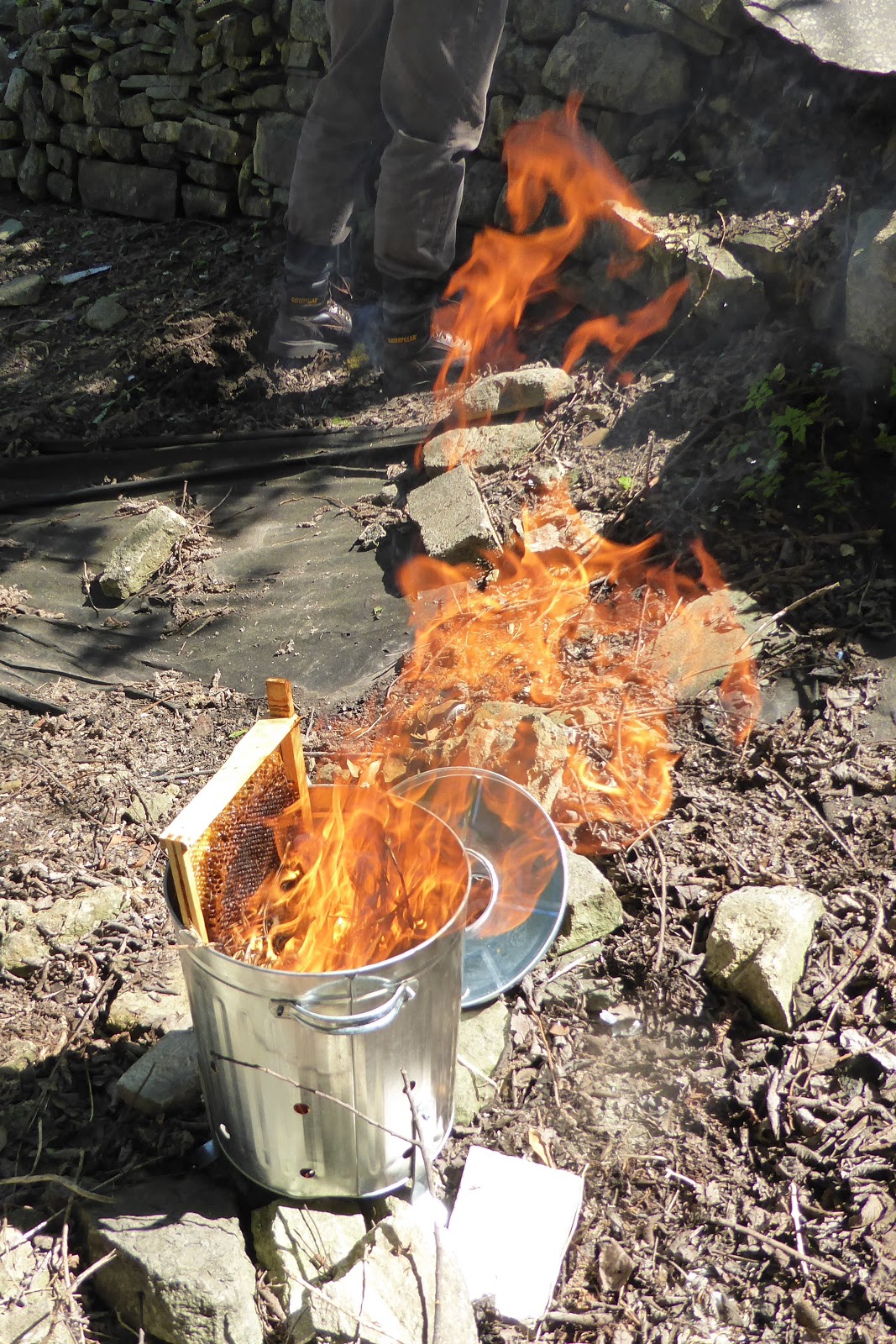
In case you were in any doubt - beeswax is very, very flammable! The other three frames went up a treat, too.
So, that was Saturday. Stay tuned for Sunday's action, including a blast from the past, and one very unwelcome guest...
Monday, 19 June 2017
Monday, 12 June 2017
A Coalition of Colonies
So, in a week where "strong and stable" turned out to be anything but, let's have a run-down of what the bees were up to when I checked in on Saturday:
However, the next thing I saw was odd - some dead brood (maybe 4 or 5 larvae), roughly 5-6 days old. This is a worry, as dead brood can be a sign of disease. The three diseases I was concerned about are, in ascending order of terribleness:
American and European foulbrood are both notifiable diseases - if I have either of those, I need to notify DEFRA immediately, and there is a risk that all my hives would need to be destroyed. However, the dead brood were still white, not discoloured in any way and not twisted.
One of the tests for foulbrood is the "matchstick test". I pushed a matchstick into a couple of larvae - the skin offered a little resistance before breaking, and then the milky haemolymph leaked out. The haemolymph looked completely normal, was the right colour and not at all sticky. This was reassuring - with EFB and AFB the larva become sort-of "melty", but mine weren't like that.
Nucleus #1 (the Brown Nuc)
The queen who started laying last week is doing well. The brood nest looked good, the eggs that I saw last week were now 8-day-old brood, and the bees have started to cap the cells. In a fortnight, these will emerge as the next generation of adult bees.Nucleus #2 (the Blue Nuc)
This is Miriam's new home. The colony is OK and Miriam is laying. However, I noticed two things. Firstly, even though I have been feeding the bees all week, they still have no stored syrup/nectar/honey. This is a little surprising, though the weather has been poor this week, so possibly they have been using it for energy and brood food as soon as they have taken it from the feeder.However, the next thing I saw was odd - some dead brood (maybe 4 or 5 larvae), roughly 5-6 days old. This is a worry, as dead brood can be a sign of disease. The three diseases I was concerned about are, in ascending order of terribleness:
- Chalk Brood
- European Foulbrood (EFB)
- American Foulbrood (AFB)
American and European foulbrood are both notifiable diseases - if I have either of those, I need to notify DEFRA immediately, and there is a risk that all my hives would need to be destroyed. However, the dead brood were still white, not discoloured in any way and not twisted.
One of the tests for foulbrood is the "matchstick test". I pushed a matchstick into a couple of larvae - the skin offered a little resistance before breaking, and then the milky haemolymph leaked out. The haemolymph looked completely normal, was the right colour and not at all sticky. This was reassuring - with EFB and AFB the larva become sort-of "melty", but mine weren't like that.
It's possible that it's chalkbrood, though I didn't see any other symptoms apart from the dead brood lying in line with the cell. It may also be possible that the hive is struggling to feed the brood because they don't have any food stores. I will have a very close look through next week, and see if the situation has improved.
Meanwhile, I'm going to keep feeding them - here's a picture of the nucleus with its temporary "loft extension" where the feeder tray is kept:
Hive #1 (no queen)
This was Miriam's hive until last week. The bees were in a much better mood this week! I only opened up briefly, to check that the bees have made some queen cells. Indeed they have - I spotted 2 on the 3rd frame that I inspected. That was all I needed to see - I will open up next week and identify the "best" queen cell, and remove the others to prevent the bees from swarming.
Hive #2 (new queen)
This colony, who were in a good mood last week, were most cantankerous this weekend. After the first couple of stings, I switched to my heavy gloves, which I don't like using but there comes a point when being stung just becomes tedious.
Still, the good news is the queen is now laying! No capped brood yet, but plenty of eggs and the oldest uncapped brood looked to be about a week old. I didn't see the queen, though I wasn't really looking for her. She has laid a lot of eggs, so she appears to be a good queen. I hope that her daughters are a lot more gentle than her sisters, but it will take about a month before there are enough new bees for the difference to be noticeable.
However, one thing I saw surprised me - queen cells! The oldest was about 4 days old, and I counted at least three with queen larvae and royal jelly. So, not only are the bees being aggressive little b**s, they are also plotting a breakaway movement! With a new queen, only laying for around a week, there is no reason for them to be doing this. And yet they are.
Well, I have raised enough new queens this year and am not going through any more of this nonsense! So, I cut out all the queen cells I could find, and crossed my fingers that I'd got all of them.
I was chatting to my dad about the bees this weekend, and he asked if they were doing this because they don't like the new queen. Actually, this is indeed possible - they may be able to sense that there's something wrong with her, and are already making plans to replace her. I'll see if they are still making queen cells next week - if they are, then I may have to come up with a new plan.
Thursday, 8 June 2017
Good Girl Gone Bad...?
So, a brief run-down of the new queens before we look at last weekend's action with Miriam:
The queen in hive #2 is only a week old, so I didn't bother to look for her this week. I checked if the bees have enough space for storing more honey (they do) and closed up the hive and left them to it.
In the nucleus, I opened up, lifted the middle frame, saw the queen, and... eggs! Great news, she's already laying. I've been feeding the colony all week, because the weather has been quite variable. They now have enough sugar syrup stored in the comb, so I can stop feeding now. I'm pleased to say that their temper seemed better, too.
So, Miriam. Regular readers will know that she is my favourite queen, partly because she gave me an excellent crop of honey last year, partly because she isn't "swarmy", and partly because her workers are usually nice and gentle to work with. Not last weekend. I don't know if it's because of the weather (thunder was forecast, although there was only a brief burst in the early hours of Saturday morning). Or perhaps because the colony has got so large (really, there are huge numbers of bees now). But their behaviour was distinctly moody. They stung me before I'd lifted the first frame, and hissed every time I used the smoke to try to calm them down (it didn't really work). And there was a squadron of 10 - 15 bees who buzzed around my head for the whole session, and regularly attacked my veil. Beekeeping for me is supposed to be fun - and it almost always is - but this week I seemed to be testing their patience, and they were certainly testing mine.
As an urban beekeeper, I have a responsibility to keep well-behaved bees. Not only are aggressive bees tedious to spend time with at the weekend, but they can become a nuisance to the neighbours and I don't want to lose the goodwill that we have built up in our local community. So, something had to be done. I had been thinking about managing the succession anyway - this is Miriam's third season, and I don't like to keep queens for longer than three years. I'd been waiting until the queen replacement in hive #2 was complete, before taking any action. Now that the queen in the nucleus is laying, and the queen in #2 should also be laying by next weekend, I decided I'd put it off long enough. It was time for Miriam to move out.
My second nucleus was empty, and so I moved it down next to the hive, braved the stings, and moved 5 frames of brood and workers into it. Now, with only half as many bees in the brood box, it was quite a bit easier (and safer!) to go through and look for Miriam. She was actually still in the brood box, so I swapped a frame out of the nuc, put the frame with Miriam on into the nuc, and closed it up.
The last job was to put 5 new frames into the hive, and close that up too. Within a day, the bees should notice that Miriam is no longer present and start making queen cells. I'll check at the weekend and see if they have.
So, I now have:
It's getting busy!
The queen in hive #2 is only a week old, so I didn't bother to look for her this week. I checked if the bees have enough space for storing more honey (they do) and closed up the hive and left them to it.
In the nucleus, I opened up, lifted the middle frame, saw the queen, and... eggs! Great news, she's already laying. I've been feeding the colony all week, because the weather has been quite variable. They now have enough sugar syrup stored in the comb, so I can stop feeding now. I'm pleased to say that their temper seemed better, too.
So, Miriam. Regular readers will know that she is my favourite queen, partly because she gave me an excellent crop of honey last year, partly because she isn't "swarmy", and partly because her workers are usually nice and gentle to work with. Not last weekend. I don't know if it's because of the weather (thunder was forecast, although there was only a brief burst in the early hours of Saturday morning). Or perhaps because the colony has got so large (really, there are huge numbers of bees now). But their behaviour was distinctly moody. They stung me before I'd lifted the first frame, and hissed every time I used the smoke to try to calm them down (it didn't really work). And there was a squadron of 10 - 15 bees who buzzed around my head for the whole session, and regularly attacked my veil. Beekeeping for me is supposed to be fun - and it almost always is - but this week I seemed to be testing their patience, and they were certainly testing mine.
As an urban beekeeper, I have a responsibility to keep well-behaved bees. Not only are aggressive bees tedious to spend time with at the weekend, but they can become a nuisance to the neighbours and I don't want to lose the goodwill that we have built up in our local community. So, something had to be done. I had been thinking about managing the succession anyway - this is Miriam's third season, and I don't like to keep queens for longer than three years. I'd been waiting until the queen replacement in hive #2 was complete, before taking any action. Now that the queen in the nucleus is laying, and the queen in #2 should also be laying by next weekend, I decided I'd put it off long enough. It was time for Miriam to move out.
My second nucleus was empty, and so I moved it down next to the hive, braved the stings, and moved 5 frames of brood and workers into it. Now, with only half as many bees in the brood box, it was quite a bit easier (and safer!) to go through and look for Miriam. She was actually still in the brood box, so I swapped a frame out of the nuc, put the frame with Miriam on into the nuc, and closed it up.
The last job was to put 5 new frames into the hive, and close that up too. Within a day, the bees should notice that Miriam is no longer present and start making queen cells. I'll check at the weekend and see if they have.
So, I now have:
- A hive with a mating queen
- A hive with no queen
- Two nucleus boxes, both with laying queens
It's getting busy!
Sunday, 28 May 2017
I'm Pickin' Up Good Vibrations
I went to the apiary this morning for Miriam's weekly inspection. As usual, everything in her hive is fine, the bees are well-behaved and there were a few empty queen cups but no signs of swarm planning. She is such an easy-going queen...!
Then, I decided to have a sneak peak in the nucleus. The bees were noticeably calmer than on Friday - which I took to be a positive sign. Then, when I was inspecting the second frame I heard a distinctive sound, pitched between G natural (783.99 Hz) and G# (830.61 Hz) - a long note lasting around a second, followed by two shorter ones. It sounds almost like a "D" in Morse Code, but slowed down. I knew immediately what this was - a new queen, piping!
Queen piping is a phenomenon only heard when there is a newly emerged queen, usually less than a week old. There are a few opinions about why new queens do this, but the one that seems most likely is it is part of the process of establishing that the hive has a queen. Worker bees are normally aware of the presence of a queen from the pheromones she produces. However, newly-emerged queens produce less pheremone. So, the piping seems to be a way of announcing herself to the rest of the hive, to cover the period until she is producing enough pheremone. She is, literally, playing her own royal fanfare! If we were to anthropomorphise this any further, we might expect her to be a little disappointed that she has to play the fanfare herself. But that's bees for you...
The mechanism by which she does this is interesting - and I was lucky enough to watch it for myself today. The queen will stop at a certain point on the wax comb, grip with her feet and press the underside of her thorax onto the comb. She then vibrates her thorax (using her wing muscles, I assume) and the vibrations reverberate through the comb. Any worker bees on the same comb will be in no doubt that a queen is present, as they will feel the vibrations. I wonder if this also has a secondary function of strengthening the queen's wing muscles, as she will shortly have to leave the hive to go on mating flights.
So - a new queen in the nucleus - what good news!
I decided to push my luck a little further, and see what was happening in the queenless hive. The bees were still in a decidedly truculent mood, so I was pessimistic. I got to the frame with the queen cell on it, and could see the end nicely chewed until it was paper-thin. But, it was still sealed. At this point, I decided to do something I have read about, but never before tried myself. I played midwife! Carefully, with the sharp corner of my hive tool, I picked at the end of the queen cell until there was a small tear in the wax. I was delighted to see movement - the head of the queen bee inside the cell. After I'd held the frame for a minute more, she finished nibbling open the end and marched straight out of the cell. New queens move really fast - the movement is actually quite distinctive, which makes them fairly easy to spot. No piping this time, as she was walking over the backs of the worker bees. I decided to close up the hive straight away, and let her get on with the important job of getting to know her new kingdom.
So, what a difference from the frustration of Friday - two new queen bees! Yes, I am feeling very proud!
Saturday, 27 May 2017
One Queen, Two Queen, Hatched Queen, Flew Queen
So, if you read last week's Update on the Queens, you'll know that I was expecting a queen to emerge from the queen cell that the bees have been carefully growing and nurturing. So yesterday I opened up the hive to see if she has indeed emerged. Regular reader Stewart was on-hand to take photos, and when we lifted the frame with the queen cell, we saw this:
You can see that the end of the cell has been carefully cut through, and at the bottom end a flap of wax has hinged open. The queen is out! But where is she?
There was only one way to find out - I needed to go through every frame, and try to find the queen. The first thing I noticed is the bees were still in a bad mood. This was surprising, as they usually calm down when the new queen emerges. Then, 4 frames in, I found two "emergency" queen cells, still unopened. I thought I'd checked through very carefully last week, but clearly I hadn't checked well enough. And, given the colony size (very big!) and the weather (warm and sunny), I started to suspect that the queen may have emerged and then swarmed. Bees will do this if the colony is big and there are other queen cells in reserve. I had to be sure, so I kept going. More queen cells on frame 5, and still no sign of the queen. I pressed on, and didn't see her anywhere in the brood box.
Back to the super box, and I went through frame-by-frame - still no sign of the queen. Then, on the 8th frame, I found this:
Another primary queen cell! I'd made the mistake of not looking through the super frames last week (I'd taken several stings by that point, and decided to give up), and therefore never seen this queen cell before. So, what to do?
Firstly, I had to decide whether I had a queen or not. There were two possibilities:
So, that's the plan. Will it work? Difficult to say - so far the bees haven't thought much of my plans, they seem to prefer their own!
You can see that the end of the cell has been carefully cut through, and at the bottom end a flap of wax has hinged open. The queen is out! But where is she?
There was only one way to find out - I needed to go through every frame, and try to find the queen. The first thing I noticed is the bees were still in a bad mood. This was surprising, as they usually calm down when the new queen emerges. Then, 4 frames in, I found two "emergency" queen cells, still unopened. I thought I'd checked through very carefully last week, but clearly I hadn't checked well enough. And, given the colony size (very big!) and the weather (warm and sunny), I started to suspect that the queen may have emerged and then swarmed. Bees will do this if the colony is big and there are other queen cells in reserve. I had to be sure, so I kept going. More queen cells on frame 5, and still no sign of the queen. I pressed on, and didn't see her anywhere in the brood box.
Back to the super box, and I went through frame-by-frame - still no sign of the queen. Then, on the 8th frame, I found this:
Another primary queen cell! I'd made the mistake of not looking through the super frames last week (I'd taken several stings by that point, and decided to give up), and therefore never seen this queen cell before. So, what to do?
Firstly, I had to decide whether I had a queen or not. There were two possibilities:
- I have a queen, but she is out mating
- I had a queen, but she has swarmed
Scenario [1] was possible, but I would have expected the bees to be in a better mood if the queen had stayed. So, I decided I had to accept that she had probably swarmed. What to do next?
There is a risk that each queen in each of the remaining queen cells will also swarm, until they are down to the last queen cell. I need to minimise the chances of that happening. So I decided to split the colony, and spread the risk.
I took out frames 1-5 from the brood box, where I'd seen the emergency cells, and put them (with plenty of bees) into a nucleus box. I then put 5 new, empty frames into hive and closed up. Here's what I now have:
- The hive contains (probably) one primary queen cell (on super frame #8). I'm expecting the queen to emerge in the next couple of days, and hopefully not swarm. She will then take over the hive.
- The nucleus contains 3 or 4 queen cells. I'm hoping the bees will recognise that their colony is too small to swarm, and that when the first queen emerges she will kill her sisters and take over the colony.
So, that's the plan. Will it work? Difficult to say - so far the bees haven't thought much of my plans, they seem to prefer their own!
Tuesday, 23 May 2017
Update on the Queens
Here's a quick update on what's going on with the queens in my hives:
Miriam's bees were very well behaved when I opened up their hive on Sunday. There were a few "queen cups", but none of them had eggs in them. From this, I conclude that they are not planning to swarm at the moment, probably because it rained on most days last week. Now that the sun is out, I will need to keep a closer eye on them in case they change their minds!
I took Caroline out and moved her into the nucleus box two weeks ago. You may remember that this was because I found a queen cup with an egg in it. This has now been grown into a lovely big queen cell, with the new queen pupating inside. This is very good news!
However, the bees have developed an "insurance policy". As well as the queen cell that they planned, they had also created four "emergency" queen cells, as backup in case there's a problem with the one they planned. So, basically, the hive had an heir, and four spares.
This is good for the bees, but not so good for me. A beehive normally only has one queen, and this situation could lead to (up to) five queens emerging from their cells this week. The problem comes down to this: if I were to leave more than one queen cell in the hive, the queens will either fight or swarm when they emerge from the cells - and I don't want either to happen.
So, the main job of Sunday afternoon was to go through and remove the other queen cells, leaving just the big one. This should have been a straightforward job - apart from needing sharp eyes to spot the additional cells, there really isn't much to it. Unfortunately, the bees were very defensive on Sunday (no doubt defending their precious queen cells) so I got several stings for my trouble. Still, I got it done in the end.
Fellow Widcombe resident Stewart was on hand to take some photos, and got this great picture of the queen cell:
If you look closely (you'll probably have to view the photo full-screen), you'll notice that the (bottom) end looks a little ragged and there is a darker band around the cell near the bottom tip. This is because the queen is nearly ready to emerge (around 1-2 days from emerging) so the worker bees are chewing away the cell tip to make the wax layer thinner, so that it will be easier for the queen to bite through the wax and emerge. You can actually see the worker bees nibbling away in the photo!
Based on when I first saw the egg, and the condition of the queen cell in the photo, I would estimate that the cell is 14 days old. Queen bees emerge 16 days after being laid, and the photo was taken two days ago, so hopefully I should have a new queen bee today!
This next photo is interesting - one of the queen cells got sheared off as I was removing a box of frames for the inspection. This cell was probably 10-11 days old, i.e. recently capped and still had royal jelly inside (the queen larva hadn't yet eaten it all). In this picture you're looking from the bottom of the cell (sheared off around half-way) up to the top. The queen larva has been removed, and you can see the layer of royal jelly. The worker bees are taking an interest because they are going to eat the royal jelly, prior to dismantling the cell:
The next inspection will be on Saturday - hopefully I will get my first look at the new queen!
Miriam's Hive
Miriam's bees were very well behaved when I opened up their hive on Sunday. There were a few "queen cups", but none of them had eggs in them. From this, I conclude that they are not planning to swarm at the moment, probably because it rained on most days last week. Now that the sun is out, I will need to keep a closer eye on them in case they change their minds!
The Queenless Hive (Formerly Caroline's Hive)
I took Caroline out and moved her into the nucleus box two weeks ago. You may remember that this was because I found a queen cup with an egg in it. This has now been grown into a lovely big queen cell, with the new queen pupating inside. This is very good news!
However, the bees have developed an "insurance policy". As well as the queen cell that they planned, they had also created four "emergency" queen cells, as backup in case there's a problem with the one they planned. So, basically, the hive had an heir, and four spares.
This is good for the bees, but not so good for me. A beehive normally only has one queen, and this situation could lead to (up to) five queens emerging from their cells this week. The problem comes down to this: if I were to leave more than one queen cell in the hive, the queens will either fight or swarm when they emerge from the cells - and I don't want either to happen.
So, the main job of Sunday afternoon was to go through and remove the other queen cells, leaving just the big one. This should have been a straightforward job - apart from needing sharp eyes to spot the additional cells, there really isn't much to it. Unfortunately, the bees were very defensive on Sunday (no doubt defending their precious queen cells) so I got several stings for my trouble. Still, I got it done in the end.
Fellow Widcombe resident Stewart was on hand to take some photos, and got this great picture of the queen cell:
If you look closely (you'll probably have to view the photo full-screen), you'll notice that the (bottom) end looks a little ragged and there is a darker band around the cell near the bottom tip. This is because the queen is nearly ready to emerge (around 1-2 days from emerging) so the worker bees are chewing away the cell tip to make the wax layer thinner, so that it will be easier for the queen to bite through the wax and emerge. You can actually see the worker bees nibbling away in the photo!
Based on when I first saw the egg, and the condition of the queen cell in the photo, I would estimate that the cell is 14 days old. Queen bees emerge 16 days after being laid, and the photo was taken two days ago, so hopefully I should have a new queen bee today!
This next photo is interesting - one of the queen cells got sheared off as I was removing a box of frames for the inspection. This cell was probably 10-11 days old, i.e. recently capped and still had royal jelly inside (the queen larva hadn't yet eaten it all). In this picture you're looking from the bottom of the cell (sheared off around half-way) up to the top. The queen larva has been removed, and you can see the layer of royal jelly. The worker bees are taking an interest because they are going to eat the royal jelly, prior to dismantling the cell:
The next inspection will be on Saturday - hopefully I will get my first look at the new queen!
Monday, 15 May 2017
Caroline's New Home
I mentioned in last week's post that our local councillor, Ian, has been helping me at the apiary so that he can improve his beekeeping skills. Well, after Caroline was moved into the nucleus last week, she was looking for a new owner. And Ian has been wanting to get some bees of his own. So, after a little bit of match-making on my part, Ian is now the owner of Caroline and her bees!
We met at dusk on Friday for Ian to make the pickup. Which sounds dramatic (maybe?) but really is just practicality - moving a nucleus during daylight hours is not a good idea, because all the foraging bees will still be outside collecting nectar and pollen. Bees stop flying when the sun sets, so dusk is the perfect time to move a nuc (or hive) to make sure that all the bees are at home.
There isn't a lot to moving a nuc or hive, actually - you need to put a ratchet strap round under the floor and over the roof to hold everything together. And the entrance block has to be rotated to the "closed" position, and held in place with gaffer tape. Once that's done, everything is bee-proof and ready to go.
We took the nuc to Ian's garden, and placed it on the spot where his hive will be. I removed the gaffer tape, but left the entrance block closed, and then left Ian to wait for an hour while the bees settled down from their journey. Ian then turned the entrance block to the "open" position, so that in the morning the bees would be able to get out and about.
We left the bees alone on Saturday, and then I went back to Ian's garden on Sunday to help move the bees into the new hive that Ian has built. We moved the bees frame-by-frame, did a quick check to see if Caroline was still present (yes) and laying (yes), and then put the roof on. Job done, and here's Caroline's new home in Ian's garden:
A brief update on my hives: Miriam's bees are doing well, and I added another box of honey frames to the hive on Saturday. I found one queen cup with an egg in it, and cut it off the comb. I will need to let the colony re-queen (i.e. replace Miriam) at some point this year, but ideally I'd prefer to wait until I have a laying queen in the other hive.
Looking into the queenless hive (formerly the Kingdom of Caroline), I located the queen cup which had an egg in it last week. The bees have done a great job and grown a lovely big queen cell - one of the best I've seen! There was another one on the adjacent frame, and no doubt there are more in the brood box, but I decided not to disturb the bees too much this week. Next week I will need to go through and remove the other queen cells, leaving just the big one.
Subscribe to:
Posts (Atom)


