Thursday, 4 April 2019

A Beginning, and an End

A Beginning

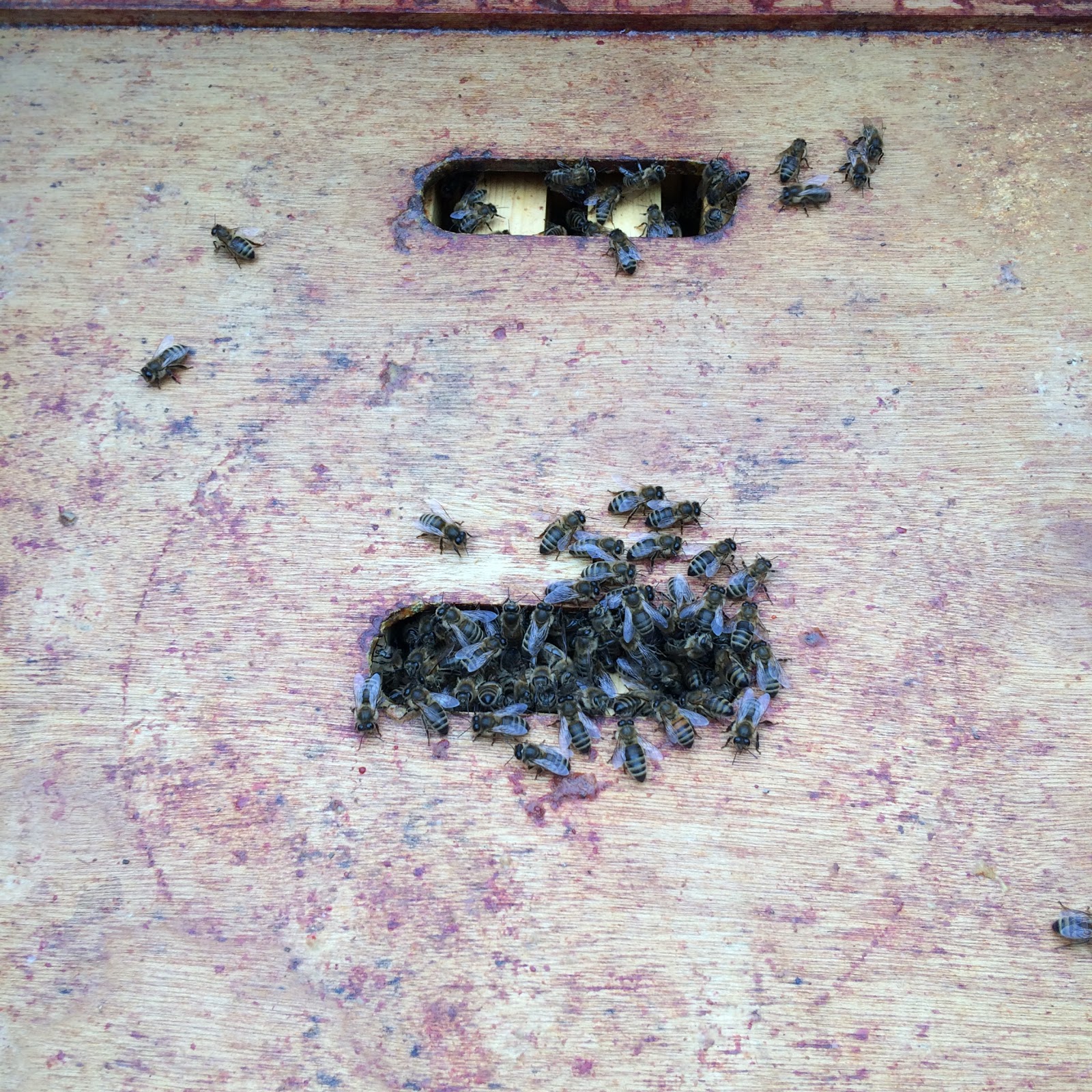
It was warm on Saturday - just warm enough to open up hive #1 (the only occupied hive) for a quick inspection.  Overall, the bees are doing fine - here's a brief list of observations:

  • There were bees on five frames.  For this time of year, that seems good.
     
  • The queen (Laura) has made it through the winter.  Also, she is laying - I saw eggs and both un-capped and capped brood.  The capped brood is worker (not drone) so that is also a good sign.
     
  • Some of the pupating brood - which should have been capped - weren't, or were only partly capped.  This is a slightly worrying sign, and I shall need to read up on possible causes.
     
  • There were a few dead bees in the hive.  Also, it looked like a couple of the larvae were not developing properly.  It didn't look like Sacbrood, but as there were only a couple I couldn't be sure.  I will need to keep an eye on this.
     
  • It may just be that the brood is cold (the hive is in almost permanent shade) and when the weather is warmer these problems disappear.
     
  • But it could be a sign of something worse.  For now there is no way of knowing.

Still, having done the first inspection, and re-configured the hive to its summer configuration (with the brood box at the bottom and queen excluder directly above it) my beekeeping year has officially begun.  Fingers crossed for good weather, healthy bees and plentiful honey.

An End

Many of my subscribed readers will know about our cat, Patsy.  On Friday, Pats was suddenly taken very ill, and we had to rush her to the vet.  Sadly, this is not a story with a happy ending.  The vet's opinion was that her condition was not going to improve, and in order to save her further distress we made the heartbreaking decision to let Patsy settle down to sleep for the last time.  Pats had been with us since she was approximately 8 years old, and had reached the grand old age of 19½.  A good age for a cat, although I wish she could have lived for ever.  Sadly it was not to be.

This is my very first picture of Patsy, taken just after she'd moved in.  October 2007.

Mrs Beekeeper and I rescued Pats from the mean streets of Willesden Green, when we lived in a ground floor flat.  Later, we moved to a house in Acton, which is when I got my first bees.

My very first bees, just after they'd arrived in a nucleus.  Pats is keeping an eye on them!

Patsy took some interest in the bees, and would sometimes watch from a safe distance when I opened up the hives.  She would also sometimes sit underneath the hives, and I used to wonder whether the sound of buzzing seemed like purring to her.

Patsy watching the bees.

After we moved to Bath, and the hives were located in Gill and Nev's garden, Pats would sometimes follow me along the path from my garden to the apiary.  Provided it didn't interfere with her other plans, of course.  While I got on with my beekeeping, Pats would sniff around the garden, and sometimes climb the willow tree to get a better view.

Climbing the willow tree in the apiary.

Pats was a practically perfect puss.  Our house is too quiet without her, and I shall miss being her butler and her doorman.  I don't know whether we go anywhere after the end.  But if we do, I hope Patsy is somewhere warm and sunny, with a few shady shrubs, some branches to climb up and down, birds to watch, and catnip to sniff.  That was Patsy's perfect day; she had many of them, and she deserved every single one.

Patsy having a perfect day in the garden.

Monday, 25 March 2019

The One That Didn't Make It

Last weekend I saw there were no bees flying in or out of hive #2.  So I took a quick peek under the roof, and my fears were confirmed - unfortunately, the colony hasn't made it through the winter.

There are a number of reasons why a colony is lost over winter.  Starvation is one, but I know that's not the case - there was still plenty of honey inside the combs in the hive.  Another possibility is infection - which can be caused and/or exacerbated by Varroa infestation.  I did see a couple of bees with mites on them, so this could be a possibility.

However, one of the more likely possibilities is that the colony was too small to keep warm through the couple of cold snaps that we had this winter.  I knew the colony was small - they'd been moved from the nucleus at the end of July, and their queen was a July hatchling.  This meant they were very late starters, and there was just not enough of the season left for them to build up numbers.

So, on Saturday, I went over to take a few photos and then brush all the dead bees off the hive floor, and burn the frames.  Here's a photo of what was left - you can just about make out the queen (with a pinky-red mark on her thorax) towards the top-right of the picture:


It's not a disaster - hive #1 will start making queen cells within the next six weeks and I'll be able to re-populate when I split the colony to prevent swarming.  But it's one of those setbacks that happens from time to time, and a reminder that beekeeping doesn't always go to plan.

I never got round to announcing the name of the queen of hive #2.  Regular readers will know that I always name my queens after scientists and engineers.  So, I've decided to posthumously name the queen of hive #2 "Maryam", after Maryam Mirzakhani.

Maryam Mirzakhani was a mathematician, and professor of mathematics at Stanford University.  She was the first - and to date, only - woman to receive the prestigious Fields Medal, which is the highest award in mathematics.  It really is a big deal - the Fields Medal is like the Nobel prize for mathematics (except there is no Nobel for mathematics - the nearest equivalent is the Nobel prize for physics).

Maryam was also the first Iranian to be awarded the Fields Medal, which she received for her work in the dynamics and geometry of Riemann surfaces and their moduli spaces.  She was a member of the United States National Academy of Sciences, and an associate to the French Academy of Sciences.  Asteroid 321357 Mirzakhani is named after her.

You can find out more about Maryam here:  https://en.wikipedia.org/wiki/Maryam_Mirzakhani

Monday, 18 March 2019

When The Bee Stings - Part 1 - Biology

Science warning: this post contains actual science. You have been warned...

Since it's still cold outside, and there's no beekeeping to do, I thought I'd take a look at some of the particularities of the honey bee's life.  One of these is the sting.  As I mentioned in a previous post, the sting of a honey bee is a modified ovipositor - which is why only female bees can sting.

It's worth looking at a bit of taxonomy, because it helps to understand how bees and wasps are related, and why they both have stings.  Bees and wasps are both members of the order Hymenoptera (bees, wasps, hornets, ants, sawflies), and all Hymenoptera females have an ovipositor, and so therefore do all female bees and wasps.

Within the Hymenoptera is the infraorder Aculeata, which contains bees, ants, hornets and some wasps (but no sawflies).

Outside of Aculeata, all other members of Hymenoptera (such as the sawflies, chalcid wasps and ichneumons) are unable to sting.  But Aculeata is really interesting in the evolutionary history of Hymenoptera because the Aculeata are the only members of the order that can sting.

Actually, there are plenty of members of Aculeata that can't sting - either because their ovipositor is modified differently, or because they've lost the sting - both of which have happened over the course of evolutionary history.  But we do know that the Aculeata all descended from one common ancestor species that lived sometime between 224 and 190 million years ago around either the end of the Triassic period or the beginning of the Jurassic.  And that species had a sting.

We also know that the bee lineage (the clade Anthophila) separated from the ancestor of common wasps and hornets (the subfamily Vespinae) around 130 million years ago.  An interesting thing happens after the lineages separate - the chemistry of the venom changes with evolution.  In the bee lineage, stings are acidic, whereas wasp stings are alkaline almost neutral (it is commonly thought they are alkaline, but it's not actually true).  More on that to come in part 2...

Back to taxonomy;  following the family tree down further, we get to the family Apidae and sub-family Apinae.  And finally we arrive at the genus Apis, which is the collection of 7 species that are referred to as honey bees.  My bees are the species Apis mellifera, but this is not the only species that are kept by beekeepers - in Asia, beekeepers keep colonies of Apis cerana.  On the other hand, Apis florea and Apis dorsata are not kept species - though people do harvest the wax and honey from wild colonies.

If we look back to evolution we find that the common ancestor of the Apis genus lived around 55 million years ago.  And that common ancestor probably had a barbed sting, which is a feature common to honey bees.  Other Hymenoptera didn't get this mutation, which is why honey bees are the only Hymenoptera that have a barbed sting - so they're the only ones that die when they sting you.

The actual structure of the sting is interesting.  The bit that penetrates the skin is, in simple terms, composed of three structures.  There is a pointed structure called the stylet, and two barbed structures called the lancets.  These are arranged roughly in a triangle, with a central canal running down the middle of the triangle.  The venom is delivered through the canal.

Diagram of a honey bee sting

At the internal end of the stylet is a bulb, which is the venom gland.  And at the internal end of the two lancets are two pairs of muscles.  When the bee stings, these muscles cause the lancets to slide up and down along the shaft of the stylet.  This is the clever bit - when one lancet moves up, the other moves down, and vice-versa.  And because of the barbs, which grip on the up-stroke but not the down-stroke, it has the effect of pulling the sting further down and deeper into the skin of the victim.  Even more clever - after the bee flies off, tearing the sting away from her body and leaving it embedded in the victim, the muscles keep working, the sting continues to dig into the victim's skin and the venom keeps pumping out of the bulb and into the victim.

So next time you're stung by a bee, just remember that you have had personal contact with a really amazing piece of evolution.

Further Reading

If you like reading science (and who doesn't?!) then this link is a fascinating analysis of the evolutionary history of Hymenoptera.  And if you'd rather just look at pictures, then the cladogram (family tree) on page 1015 is a joy:
https://www.cell.com/current-biology/pdf/S0960-9822(17)30059-3.pdf

This is a much more comprehensive description (with diagrams!) of the structure of the bee sting:
http://www.dave-cushman.net/bee/stingstructure.html

Wednesday, 16 January 2019

Feed The Bees

It feels like winter has been fairly mild, so far.  This isn't actually good news for my bees - they're supposed to be clustered in a tight ball inside the hive, and not moving round very much.  Instead, they are taking advantage of the warm weather, and spending time outside the hive flying and foraging.  The problem with this is it uses energy, which they would normally replace by feeding on nectar.  But of course it's winter, so apart from the odd daphne bush or winter jasmine, there isn't much nectar to be found.  So the bees are getting home tired and hungry, and eating through their stored honey (which is supposed to last them until the end of April).

Hive #1 is particularly affected as they have a much larger number of bees - which means more hungry mouths to feed, and faster depletion of their stores.  So, on Saturday I decided to top up their food to get them through until spring.

I've posted before about feeding bees - but that was using liquid feed (syrup).  In winter, the bees are unable to evaporate off the water from sugar syrup, because it's too cold and damp.  So feeding them syrup won't help them.  Instead, I need to feed them fondant, which they will ingest directly in the same way as honey (i.e. they don't need to process it first).  I had a 2.5 kg bag of fondant ready:


First, I needed to cut the bag open and fold the flaps back (as you can sort-of see in the photo above).  Then, it should be a simple matter of putting the bag, hole-downwards, over one of the holes in the crown-board.  Except...


... it was a fairly warm day, and there were lots of inquisitive bees who wanted to see what was going on!  Time to improvise - I borrowed two of the sliding entrance blocks to cover the crownboard holes, and make things a bit easier:

That's one...

... and the other!

It was then a fairly simple matter of putting the bag onto the crownboard, sliding it over the hole (while simultaneously sliding the entrance block out of the way) and trying to line up the bag hole with the crownboard hole (which requires a bit of guesswork):


And we're done!  Hopefully the bees will enjoy their sugary treat, and it will keep them going until spring.

Sunday, 11 November 2018

Last Tasks of the Year

Now that harvest is over, there have just been a couple of tasks left before winter.  The first was to change the hive configuration and move the super of winter honey under the brood box.  Some beekeepers do this, others don't.  But it's the way I was taught, and I have never lost a colony in winter, so it's a technique that works for me.

I did the switch-over last month.  The brood boxes are heavy at this time of year, so it was a two-person job.  Fortunately, the bees' landlord, Nev, was on hand to assist!

Regular readers will remember the incident last year when I found a false widow spider living under one of the hand-holds on the brood box of hive #2.  I certainly remembered - and made sure to check under the hand-holds this time, before moving the brood boxes.  I'm glad I did, as a peek at the back of brood box #2 revealed this:

Uninvited guest!

Fortunately, this time I was prepared to face my nemesis.  And, naturally, as a committed enemy of spider-kind, there was only one course of action - a swift blow from the blunt end of my hive tool.  This particular spider did not live to see another day.

The last task was undertaken today, when I put the mouse-guards onto the hive.  These are perforated metal strips with holes large enough to let bees in and out, but small enough to prevent any mice from getting into the hive.  They look like this:

Mice not welcome.

Now that the final tasks of the season are complete, I can relax and leave the bees to their own devices until the warmer weather comes in the spring.

Tuesday, 16 October 2018

Harvest Time

I'm a bit late with this post, as I actually harvested a couple of weekends ago.  The good news - I got some honey.  The bad news - not very much, only 13 jars in total.  That makes for just under 10 lbs of honey, which is pretty poor.  Nevertheless, at least I have two healthy colonies going into winter, and that's the most important thing.

Now for the weird news...  The honey has ivy nectar in it.  this means that it has a somewhat distinctive taste to it.  Ivy honey (and honey that is part-ivy, like mine) has a complex flavour that is less sweet than other honeys, with a distinct, earthy taste.  Descriptions include autumnal, like new leather, or woody.  I quite like the taste.  Mrs Beekeeper is not so keen.  So, it's not to everyone’s taste, but is one for the more discerning palate.

Here is the obligatory shot of the produce, before I delivered it to our exclusive retailer Widcombe Deli:


Wednesday, 19 September 2018

Autumn Update

Apologies for not posting for a while - for various reasons, my bees have had to take a bit of a back seat while I've been getting on with a variety of other things through summer and early autumn.  Anyway, here's a bit of a progress update:

In my last post - back at the beginning of July - I found hive #2 empty, and burned the frames.  I left the hive empty for a while, and waited for the new queen in the blue nuc to emerge, mate and start laying.  She hatched out of her wax queen cell during the first week of July, and by the third week she was laying.  At the end of July I moved the colony from the nucleus into hive #2.  They slowly built up numbers (and comb) through August, though they hadn't collected anything in terms of honey.

Back in Hive #1, Laura's bees have filled two supers (of 10 frames each) and left another half-filled.  One of the full supers is theirs - they'll need the honey to get through winter.  The second, I will extract.  The last time I checked, the honey was still a little runny, so I'm leaving it for a bit longer while the bees evaporate off the water and get the honey to the correct constituency (18% water, 82% sugar).

I decided to move the half-filled super to hive #2, to get them started on their winter stores.  I've also been feeding them - at the beginning of September, I bought 24 x 1kg bags of sugar.  They've gone through 14kg already!  But at least the super is feeling a lot fuller.  Also, they are starting to deposit honey (or, to be strictly accurate, sugar syrup) into the brood frames, as you can see from this photo:


The other thing I've noticed is that hive #1 has a really large amount of bees, while hive #2 (having changed queens late in the season) has been struggling to build up numbers.  So I've been donating frames of capped larvae from Laura's hive to #2, to try to even the numbers up.  The number of bees in #2 has certainly increased over the last three weeks, so it seems to be working.

Coming up in the next post - the long-overdue naming of the queen in #2...!