Thursday, 4 June 2020

Introducing... Queen Ottoline!

Every beehive has a single queen bee, and the queen in the nucleus is called Ottoline. She is named after Professor Dame Ottoline Leyser, who is a British plant biologist and Professor of Plant Development at the University of Cambridge, as well as being the director of the Sainsbury Laboratory.

Ottoline studied at the University of Cambridge for both her BA and PhD degrees, and then undertook post-doctoral research at Indiana University.  In 1994 she worked at the University of York, before moving to Cambridge in 2010.

Ottoline's research includes the genetics of plant development and the interaction of plant hormones with the environment.  Notable achievements include the identification of the auxin receptor, which is a hormone that controls shoot architecture and development in plants.  She also played a key role in promoting Arabidopsis thaliana as a model organism in plant biology research.

Undertaking world-leading research has earned Ottoline a number of awards, including Commander of the Order of the British Empire (CBE) in the 2009 New Year Honours.  She was appointed Dame Commander of the Order of the British Empire (DBE) in the 2017 New Year Honours for services to plant science, science in society, and equality and diversity in science.  Other awards include the Rosalind Franklin Award (2007), the Genetic Society Medal (2016), and the EMBO Women in Science Award (2017).  She is a fellow of the Royal Society, an international member of the US National Academy of Sciences, a Member of the European Molecular Biology Organisation and a Member of the German Academy of Sciences Leopoldina.

At the end of this month Ottoline will become Chief Executive of UK Research and Innovation.  Fun fact: that's where I work!

In 2017 Ottoline was interviewed by Jim Al-Khalili for the BBC Radio 4 programme The Life Scientific.  You can listen for free on the BBC Sounds app, or via this link: https://www.bbc.co.uk/programmes/b08q5wxx

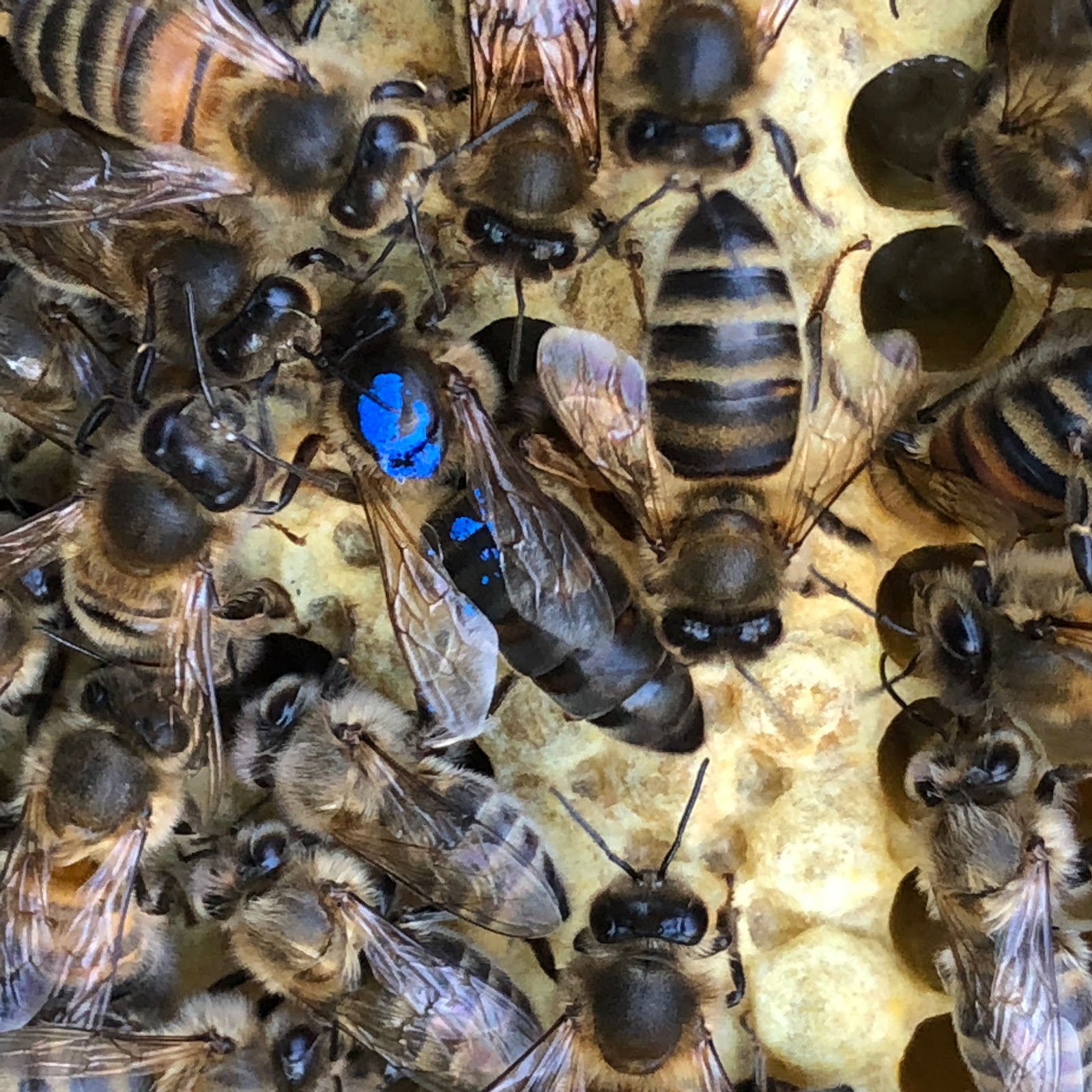
Finally - back to bees, and here's a picture of queen Ottoline:

Saturday, 16 May 2020

More Swarms!

In my last update on Sunday 3rd May, I'd finally managed to collect the swarm from neighbour Mark's garden.  The bees were safely housed in a nucleus, and everything was back to normal.  Or so I thought.

The next day (Monday 4th) they swarmed again.  I don't know why, but for some reason the bees abandoned the nucleus and headed off to another neighbour's garden (Julia's, this time).  So, off I went again, with a bucket, loppers and the now-empty nuc for round 2.  This time, they were about 8ft up in a crab-apple tree.  At least they were easy to reach this time.  Unfortunately, they were clustered around a thick branch, just at the point where it divided.  There was nothing else for it - Julia lent me a saw and I started hacking away.  Eventually, the swarm - and accompanying branch - was free:


The only way to be sure I had all the bees was to put the piece of branch - with swarm still attached - into the nucleus, and then carry it back to the apiary.  Eventually they settled down, and I'm relieved to report they didn't swarm again.

The next incident was on the bank holiday, last Friday.  I'd checked Dorothy's colony, in the brown nucleus, 6 days previously - and all seemed fine.  Unfortunately, I must have missed a queen cell, so off they went.  This time, they decided to set up home in my neighbour Darren's chimney.  There's no way I can collect them from there, so I suppose they will just set up home and have a happy summer, undisturbed by beekeepers.

That brings us to today.  I checked the blue nucleus (the Mark / Julia swarm) first.  All looked good, and the queen has started laying.  That meant I could mark her, so I popped her in the marking cage and put a dot of blue paint on her thorax.  Next, I checked the now-queenless brown nucleus.  There were a couple of queen cells, but no sign of any new queen.  I decided it would be easier for me to manage the nucs by combining them, so I prepared by removing the old frames with the queen cells (there was very little brood, so it was a good opportunity to remove the old comb and burn it).  I then replaced with fresh.  The handy thing about the brown nuc is it has a detachable floor, which allows me to put it on top of the blue nuc and make a double-height nucleus, like this:


When combining colonies in this way there is a risk that the bees will fight, so it helps if you can make them mingle slowly, so they get used to each other.  The way this is done is by putting a layer of newspaper between the two boxes.  The bees will nibble through the paper and start to circulate through the holes that they make.  This way, they get used to each other's pheromones without getting aggressive.  At least, that's the idea - I will find out next week how they've got on.

All was fine in Katherine's hive - they were very well behaved, and no queen cells.

In hive #2 I was please to see that the new queen (the one that had emerged after the swarm) had started laying.  She also got a blue dot on her thorax, and then that was the end of the day's beekeeping.  I'm pleased to note that hive #2, which has had a bit of a temper in the last few weeks, was much better behaved today.

Now that I'm back to three laying queens, I'm hoping that's the end of all this swarming nonsense and everything will be a bit more orderly for the next few weeks.  One other thing - I have two newly-marked queens, and regular readers will know that I always name my queens when I mark them.  Tune in to the next update to find out what they're called...
Sunday, 3 May 2020

Swarm... Collected!

After Friday's shenanigans, and a heavy downpour on Friday night, I was relieved to see that the bees in neighbour Mark's tree had survived the night.  They didn't seem to be in a hurry to go anywhere, so yesterday I set up a spare nucleus, with one drawn and four un-drawn frames, as near as I could to the swarm cluster.  My hope was that they might smell the wax, realise that the nuc was a nice warm dry place to live, and move in.  In the meantime, I had to wait.

I used the time to check the other hives, as I wanted to know where they'd swarmed from.  Not the nucleus - Dorothy was still at home.  And Katherine was still in residence in hive #1.  That could only mean that the new queen, who was first seen last weekend in hive #2, must have swarmed.

I had a good look inside #2, and spotted a lovely big queen cell that I completely failed to see last week.  That was my mistake - if I'd seen and removed it, the bees wouldn't have swarmed.  I could see that the new (newest) queen had emerged from the cell - and I spotted her on the next frame.  She is quite distinctive-looking, with a single ginger stripe on the anterior segment of her abdomen.  At least she should be fairly easy to find in future.

Back to the swarm.  By this morning, they still hadn't moved from the tree, and it was looking like something needed to be done - Mark and his family really needed their garden back!  So, this afternoon Amelia and I tooled up and headed round to Mark's house with a spare bee suit and a very vague idea of a plan.

Mark had a couple of ladders that we could use, and was happy to join in the fun.  So I headed up a ladder with a pair of long-handled loppers, while Amelia held on tight and Mark got ready to catch.  We had to have three goes at it, because the bees kept re-clustering on the tree.  This was how it went on attempt number one:


I didn't get a video of attempt number two, but here's the third and final try:


And it's done!  The bees are now safely at home in the nucleus - hopefully they'll stay there and we'll have no more funny business.


Friday, 1 May 2020

Swarming In The Rain...

My bees swarmed today.  We'll get to that part later - first, a bit of a catch-up on what happened last weekend, and how we got to today's events.

In my last post I talked about the surfeit of queen cells in hive #2, from two weekends ago.  So, last weekend I went back to check on how things were progressing.  Here's a hive-by-hive rundown:
  • Hive #1 (Katherine):  The colony are still building up slowly, but look healthy.  There were a couple of frames in the hive that were now two years old, and really needed to be replaced.  Both had capped and uncapped brood, and I didn't want to diminish the amount of brood too badly, so I decided to remove just one of them.  Interestingly, after I'd shaken the bees off, I noticed two queen cells - one uncapped and one capped.  I was a little lucky the bees hadn't swarmed.  I was surprised that the colony are making queen cells already, since they don't really seem big enough yet, but the weather up to last weekend had been very pleasant so perhaps they were just taking advantage of the conditions.  Anyway, I checked the rest of the frames thoroughly, didn't see any more queen cells, and burned the frame I'd removed.
  • Nucleus (Dorothy):  These bees had built up quickly, and had even started making comb in the space between the top of the frames and the roof.  In fact, after I'd taken the roof off I realised that queen Dorothy was on the roof and not on the frames where she was supposed to be.  I carefully picked her up by her wings and popped her back inside, and then removed the excess comb from the underside of the roof.
    To slow things down a bit I took two frames of drawn comb out of the nuc and donated them to hive #1, replacing with new frames.
  • Hive #2 (no queen... or...?):  I had a good look through - there were four more queen cells, which the bees had presumably decided to make just to keep me on my toes.  I removed all but one, and then checked the big queen cell that I left last weekend.  That one was open, so the queen must have emerged.  It took me a while to find her (honestly, I nearly gave up) but I did spot her eventually.  Reassured that the hive now had a queen, I removed the last queen cell and closed up.  Happy days - all three colonies have a queen!

So, the position by the end of Sunday was three colonies, all with queens and with all queen cells removed.  Great - that should have meant no risk of swarming for at least a week.

Fast forward to today, and this (it's worth having the sound turned up):


How did it happen?  I have no idea.  It wasn't great weather today - the temperature barely nudged above 12°C and it's been raining.  About half an hour after that video was taken, we had hail.  What on earth the bees were thinking, swarming in those conditions, I have no idea.  Anyway, they've done it now.  Unfortunately, they've settled about 15 feet up in a magnolia tree (they're still there as I write this) and there's no way I can get a ladder up to collect them, so they'll just have to stay there until tomorrow, when they'll presumably pick a permanent home and move in.  I've left an empty nuc with some new frames in the apiary, a little distance away from the other hives, so with a little luck they might be tempted to move in there.  Otherwise, they'll probably find a nice tree on Beechen Cliff and establish themselves as a feral colony.

One question comes to mind - which hive did they swarm from?  The answer to that will have to wait until tomorrow.  In the meantime, here's a couple of great pictures of the swarm that were captured by my neighbour Mark:

The swarm
Beekeeper fails to spot the blindingly obvious...

Tuesday, 21 April 2020

Swarm Season Starts

A couple of weeks ago, I noticed that Dorothy's bees were building up quickly, and that I'd need to keep on top of potential swarm preparations.  I was not wrong.

Last Sunday (12th April) I checked Dorothy's hive, and there were the classic signs of swarm preparation.  Firstly, drone brood - both capped and uncapped.  Secondly, a couple of emerged drones.  And thirdly - and most tellingly - a queen cup (the start of a queen cell) with an egg in it.  I had to do something.

With the country currently in lockdown and social distancing in force, the British Beekeepers Association is advising that swarm collection may be a problem if beekeepers can't maintain social distancing when collecting swarms.  The last time I collected a swarm it was a two-person job, and we were definitely less than two metres apart.  That would be a problem this year.  So, the best thing to do is avoid swarming in the first place.

I therefore split the colony, left the laid queen cup in hive #2, and moved Dorothy and five frames of bees to a nucleus.  And then waited a week.

That takes us to Sunday just past, and two tasks - check the nucleus, and check hive #2.

The nucleus is doing well.  The bees are foraging and Dorothy is laying.  There is a decent amount of brood, pollen and stores.  Hopefully they will build up nicely - but not too quickly - I don't want them to start planning to swarm again.

In the hive, the queen cup I saw last week was now a complete and capped queen cell.  There were another three on the same frame, and four more on the frame next to it.  Here's a picture of three of them:


The thing is, eight queen cells are way too many.  If I left more than one, the bees could swarm when the second (and third and fourth) queen(s) emerge.  These are called 'cast swarms' - they tend to be small and have a poor chance of survival.  So it's better just to make sure that cast swarming doesn't happen.  That means assessing the queen cells, picking a winner and removing the rest.

Whenever I do this, I always intend to keep the cell that I saw the previous week.  But when it comes to it, I more often than not change my mind.  Why?  What makes a 'good' queen cell?  I've always gone by a simple principle - bigger is better.  This is because smaller cells can restrict the growth of the queen - particularly her abdomen.  A bigger queen, with a bigger abdomen, means bigger ovaries and therefore better laying capacity.  Since egg-laying is a queen's main task, I want the best layer as this means more workers and therefore a bigger colony, with the best chance of surviving through winter.  It also means more honey, of course!

So, last week's cell looked good.  But two inches to the right was a whopper.  Very long, and already capped.  So, last week's - and the other six - unfortunately had to go.  I cut them out with my hive tool, and left the super-cell attached to the comb.  The larva inside will spend this week pupating, and should hopefully emerge as an adult queen next weekend.  If she does, I shall have to pick a name for her...

Thursday, 9 April 2020

Time to Get Outside (if you're a bee)

We humans may all be stuck inside right now, but that's not the case for the bees - we have lovely weather outside this week, and they are busily collecting the early nectar and pollen.  The gage tree in my garden has been getting plenty of visits from my bees, as well as bumbles, hoverflies, butterflies and solitary bees.

Sunday was my first inspection of the season - as is usual, I moved the supers from underneath the brood boxes and placed them on top, with queen excluders between.  Here's me hard at work (thanks to the bees' landlady Gill for the photos!):


So, a quick update on how the hives are doing:

Katherine in Hive #1

The colony has survived winter, though they are a little small.  There had been nothing stored in the super before winter, though they have managed to make do with the stores they collected in the brood box.  Because the super was empty, some spiders (all false widows - I think I counted three) had taken up residence and had been opportunistically feeding on bees that strayed too close.  The spiders were aggressively removed before the super was put back on the hive.  (Regular readers will recall this is not the first time I've encountered a false widow spider while beekeeping).

Despite the small size of the colony, they are bringing in plenty of pollen and Katherine is laying plenty of eggs.  I fact, when I spotted her there was one hanging out of the back of her abdomen, so I guess I must have interrupted her right in the middle of her important task.

Overall, good news and I expect they will start to fill the super soon.

Dorothy in Hive #2

Dorothy's hive is doing really well.  The super is half-full, and there are plenty of stores in the brood box.  Also, there are lots of eggs and a decent amount of capped and uncapped brood.  This colony looks like it is building up quickly - I should get a decent honey crop out of them this year, if I can keep on top of their attempts to swarm.  There are no signs of swarm preparations yet, but once the drones start to emerge in 2-3 weeks I think I will have my work cut out in keeping them from swarming.

I had sufficient confidence in their progress that I put a second super on hive #2 on Tuesday evening.  Hopefully this will keep the bees busy with nectar collection, and distract their collective hive-mind from thoughts of swarming, at least for another few weeks.

So, overall a good start to the season.  Nature seems to have taken advantage of us humans being locked away for a while - everything outside appears to be thriving!

Friday, 13 September 2019

Introducing... Queen Katherine!

Exciting news from the Beechen Bees apiary - I have a new queen!

At the beginning of August, the colony in hive #1 had got large enough that I felt able to do a split.  So, with the help of budding bee buddies Helen and Joel, I moved queen Dorothy - and half of the bees - out of hive #1 and into #2.  A week later, the bees in hive #1 had made a solitary queen cell, and ten days after that I saw the new queen.

But of course, she hadn't yet mated, and the weather in August was somewhat variable, so I didn't want to be too optimistic.  However, a couple of weeks ago I saw the first eggs neatly laid in cells, and then last weekend I was able to find the new queen and mark her (it's a green dot this year).  So - here she is!


As for her name - I figured that, since this year was the 50th anniversary of the first moon landing, I'd include someone who was involved in the Apollo space programme.  The Americans didn't include any female astronauts in the Apollo programme (the first women were selected for astronaut training in 1978, six years after the end of Apollo).  So I decided to pick someone from the mission planning team, and the winner is... Katherine Johnson!

Katherine Johnson is a mathematician who was employed in the 1950s as a 'computer' (in the pre-digital meaning of the word) for the National Advisory Committee for Aeronautics (NACA - the predecessor organisation to NASA).  In 1958 NACA was superseded by NASA, and Katherine moved to NASA to work as an aerospace technologist in the Spacecraft Controls Branch.  She had the job of calculating space flight trajectories, including Alan Shepard's in 1961 and John Glenn's in 1962.

Katherine later became a pioneer with digital computers and helped to develop NASA's confidence with the new technology.  And in 1969 she helped to calculate the trajectory for the 1969 Apollo 11 flight to the Moon.  Katherine wasn't done with Apollo there - when Apollo 13 'had a problem', she worked on the backup procedures and flight path navigation that returned the crew safely to Earth.

You can find out more about Katherine Johnson from her entry in Wikipedia:
https://en.wikipedia.org/wiki/Katherine_Johnson