Monday, 3 August 2020

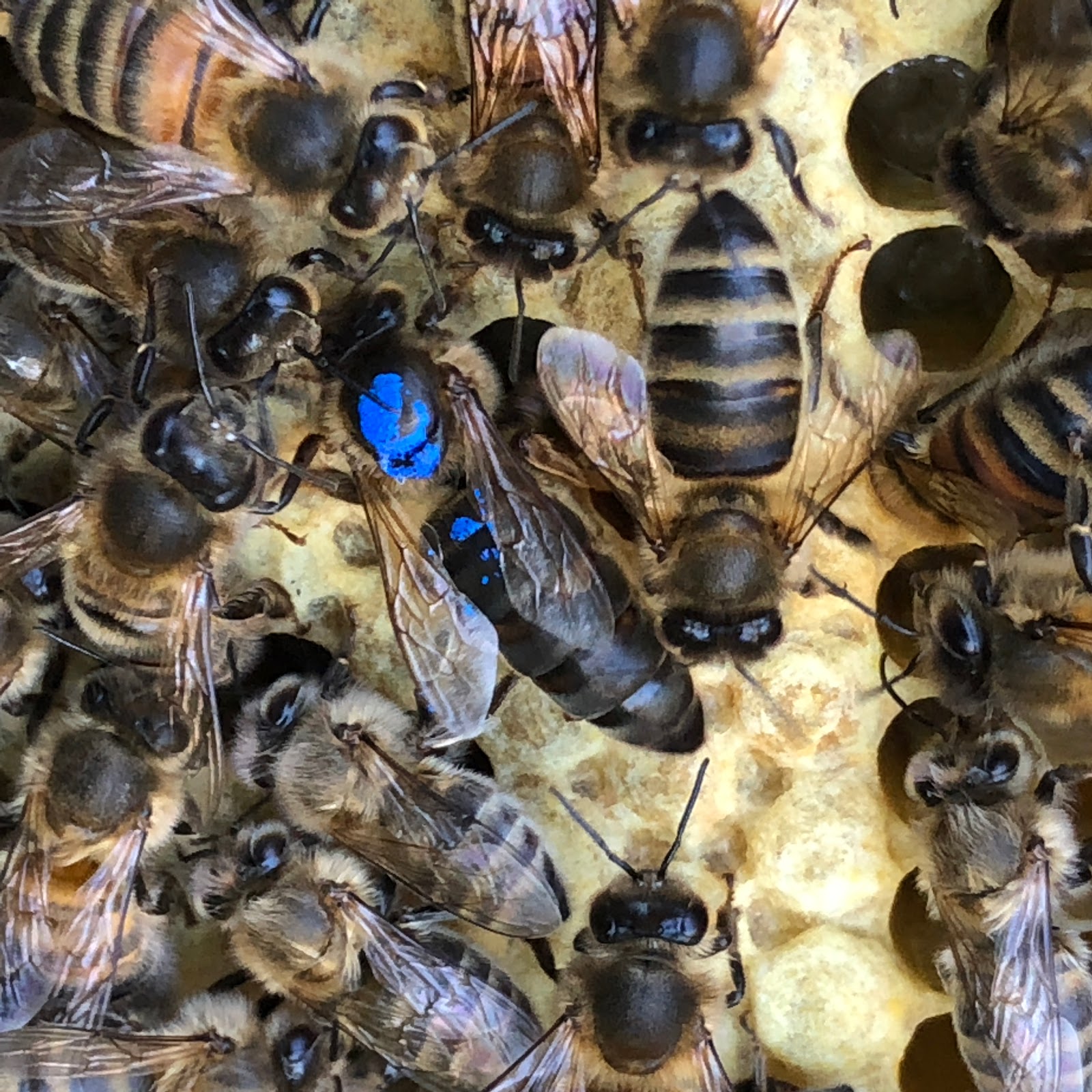
Introducing... Queen Athene!

Every beehive has a single queen bee, and the queen in hive #1 is called Athene. She is named after Professor Dame Athene Donald, who is a physicist, Professor of Experimental Physics at the University of Cambridge, and Master of Churchill College, Cambridge.

Athene read physics at Girton College, Cambridge, gaining her PhD in 1977 for research into electron microscopy of grain boundary embrittled systems.  She then moved to Cornell University working as a postdoctoral associate on research into metals.

In 1981 Athene returned to Cambridge, and took up a post in Cambridge's Cavendish Laboratory in 1983.  In 1988 she became Professor of Experimental Physics, and in 2014 became Master of Churchill College.  She was elected a Fellow of the Royal Society in 1999.

Athene's area of research specialism is in soft matter physics, and this includes the study of soft matter in living organisms as well as organic substances such as starch and proteins.  This developed from her earlier work on polymers, and includes the study of organic polymers using electron microscopy and X-ray scattering.  Her research has included structural changes to biological polymers when cooked, and amyloid folding of proteins.

Athene has been and continues to be actively involved in the promotion and encouragement of women in science.  She was director of WiSETI, Cambridge University's Women in Science, Engineering and Technology Initiative, from 2006 to 2014, and the University's Gender Equality Champion from 2010 to 2014.  She also chaired the Athena Forum - an organisation committed to the advancement of women in science in UK higher education - from 2009 to 2013.  She has served on the Gender Balance Working Group of the European Research Council, and is a Patron of the Daphne Jackson Trust.

Athene is also an advocate for interdisciplinary research, and was the founding chair of the Institute of Physics Biological Physics Group from 2006 to 2010.  She has served as a member of the Science Museum Advisory Board, and is currently chair of the Interdisciplinary Research Advisory Panel for the 2021 Research Excellence Framework.

Here is a photograph of her namesake, queen Athene:

Wednesday, 15 July 2020

New Queen!

Two weekends ago, I opened up hive #1, to check on the queen cell.  This is what I saw:


That is excellent - a textbook emerged queen cell.  It still amuses me that, when the queen nibbles the end off the cell, she doesn't remove it completely, but leaves a small 'hinge' on the lid.

Anyway, I didn't see the queen that day, and had to wait another week to see if I could spot her.  Which brings me to Sunday, when I opened the hive again and, after a little bit of peering about, saw this:


Yes, that is indeed the new queen!  If you didn't spot her, I promise she definitely is in the photo.  She's actually the one that is less stripy than all the worker bees.  So, think of it as a game of "Where's Waldo?" - except in this version, everyone is wearing a striped top except Waldo.

She's not laying yet - probably because the weather hasn't been great, so she hasn't had a chance to fully mate yet.  Hopefully that will all change by the weekend, and then I'll be able to mark her and name her.

Wednesday, 1 July 2020

Hive Swap

For a while now, June's bees in hive #2 have been a bit of a handful.  Even though I'm pretty careful when I handle them, they've been more defensive than hive #1, and they sting me fairly regularly.  Also, they have stung their landlord Nev at least once (and tried several times).  So I decided that something needed to be done.

The best option I could come up with was to swap the colony with Ottoline's bees in the nucleus.  They are very well behaved, calm, and I don't think they've stung me at all.  Normally, this would be straightforward - just pick up each hive and swap them over.  However, I'd have then ended up with the nuc where a hive should be, and it would have messed with the aesthetics of the apiary.  Which are... y'know... the most important thing.

So, I was going to have to do it the hard way.  I suited up, lit my smoker, and got ready to move the colonies frame-by-frame.  In fairness, it went pretty smoothly.  The bees were pretty well behaved throughout, and I only got one sting.

Over in hive #1, I had a look to see if they’d made any queen cells to replace Katherine (RIP).  Indeed they had - all these and more, in fact:


Here are all the cells I cut out from all the combs:


I’ve tried to arrange them in order of age from left to right, so if you look carefully (you’ll need to click on the photo to zoom) you should see the ones on the left look more ‘maggoty’, whereas you can see the ones on the right starting to differentiate into their adult segments.

I left one cell in the hive - pictured below - this will (when she hatches) become the new queen of hive #1:


I’ll take a look this coming weekend to make sure that the new queen is alive and well.

Thursday, 25 June 2020

An Accident - Or Something More Sinister?

I checked the bees on Saturday, and everything in the nucleus (Ottoline's bees) was fine.  All good in June's hive (#2) as well.

Things in Katherine's hive also looked fine - at least, at first.  There were recently-laid eggs, as well as capped and un-capped brood.  A few frames in, and I found an open queen cell, which I removed.  On the next frame were four more.  I tackled the first three, removing the small larvae and cutting out the structure of the cells to discourage the bees from re-using them.

When I got to the 4th queen cell, I noticed something odd.  Instead of the end being completely open, there was a dark shape just poking through the entrance.  At first, I thought this would be a worker bee, depositing royal jelly in the cell for the larval queen to feed on.  But, oddly, it didn't seem to be moving.  Also, it didn't look like the end of a worker bee - it didn't seem stripy enough, and it was too pointy.  I carefully cut away at the sides of the queen cell, and was amazed to pull out this:


Yep - that's Queen Katherine - dead, after being stuck head-first in a queen cell.  This is a picture showing where it was located on the frame (you can clearly see it in the corner, towards the lower part of the photo):


And here's a closer look (you can even still see specks of green paint that have rubbed off from her thorax):


This is really remarkable - it's the first time I've found a dead queen inside a hive (though I have previously seen a dead queen outside, after she was dumped there by her workers).  And the really weird thing is, it seemed from the shape of the cell - the entrance of which seemed too narrow for her to squeeze into - that the workers were sealing her in, from the outside.  This is genuinely odd - I've never seen or heard of bees behaving like this before.

So, what had happened?  Well, there are two possibilities:
  1. She'd for some reason crawled into the queen cell head-first, and got stuck
  2. The workers chased her into the cell, and killed her
Looking at option [1], it's not by any means impossible.  But it is unlikely.  A queen will always enter a queen cell abdomen-first, as she has only one business being there - to lay an egg.  She has no reason to go in head-first if the cell is empty.  And if there is already a larva in there, with royal jelly, then there's no point going in head-first either (she can't feed the larva - that's strictly a worker bee job - and she can't eat the royal jelly, as she has to be fed mouth-to-mouth by the workers).  But maybe it was a freak accident?

Or maybe not.  After all, she had laid eggs within the last day or so (I know - I saw them).  So why was she dead?  She could, perhaps, have got stuck and died - but I'm not sure there would have been enough time for her to have starved to death.  Maybe, then, she had been stung to death by the workers, who for some reason had decided to replace her.  If you look at the photo of her (click on it to see it in higher-resolution) you'll notice her wings have been damaged.  Now, that might have happened when I was getting her out of the cell.  But I suspect they may have been bitten by the workers when they attacked her.

Like inside a beehive is pretty brutal - if the workers decide the queen is not meeting their high standards, then they will cheerfully kill her off and replace her with one of their sisters.  I've had this happen a couple of times before - it's just a part of beekeeping life that you get used to.  But never before have I found the queen's body still inside the hive.  I've been keeping bees for 10 years now, and yet every season they still manage to surprise me!

In case you're wondering how the bees will cope without a queen - don't worry.  Right now, they will be making new queen cells (from the eggs I saw), and I will have a look in the hive tomorrow to see how they are getting on with raising Katherine's replacement.

Monday, 15 June 2020

Introducing... Queen June!

Every beehive has a single queen bee, and the queen in hive #2 is called June. She is named after June Almeida, who was a Scottish virologist, and a pioneer in virus imaging, identification, and diagnosis.

June started her career working in histopathology at the Glasgow Royal Infirmary, and then moved to St Bartholomew's Hospital in London.  In 1954 she moved to the Ontario Cancer Institute, where she worked as an electron microscopy technician.  While in Ontario she was awarded Doctor of Science (Sc.D.) for electron micrographic research of antibodies.

In 1964 June joined the research team at St Thomas's Hospital Medical School in London.  She worked on the hepatitis B virus and also cold viruses, as well as a new virus in humans that at the time was given the identifier B814.  June used electron microscopy to photograph organ cultures containing B814, and noticed that the structure of the virus particles was similar to two other viruses she had previously studied - infectious bronchitis of chickens, and mouse hepatitis liver inflammation.  Her previous papers on the chicken and mouse viruses had been rejected by reviewers, who believed that the viruses were actually known flu viruses.  However, with the evidence from B814, June now knew that she was looking at a new, and previously unidentified group of viruses.

June's photographs of the new viruses showed that they appeared to be surrounded by a distinctive 'halo' - caused by protein spikes on the surface of the virus.  The latin for 'halo' is 'corona', and so this family of viruses became known as 'coronaviruses'.

As well as her work on coronaviruses, June also continued to work on hepatitis B, and in the 1980s she was involved in producing micrographs of the HIV virus.  Later in her career she worked at the Wellcome Institue, and in retirement she maintained an advisory role at St Thomas's Hospital Medical School.

Here's a photo of her topical namesake, queen June:
 

Thursday, 4 June 2020

Introducing... Queen Ottoline!

Every beehive has a single queen bee, and the queen in the nucleus is called Ottoline. She is named after Professor Dame Ottoline Leyser, who is a British plant biologist and Professor of Plant Development at the University of Cambridge, as well as being the director of the Sainsbury Laboratory.

Ottoline studied at the University of Cambridge for both her BA and PhD degrees, and then undertook post-doctoral research at Indiana University.  In 1994 she worked at the University of York, before moving to Cambridge in 2010.

Ottoline's research includes the genetics of plant development and the interaction of plant hormones with the environment.  Notable achievements include the identification of the auxin receptor, which is a hormone that controls shoot architecture and development in plants.  She also played a key role in promoting Arabidopsis thaliana as a model organism in plant biology research.

Undertaking world-leading research has earned Ottoline a number of awards, including Commander of the Order of the British Empire (CBE) in the 2009 New Year Honours.  She was appointed Dame Commander of the Order of the British Empire (DBE) in the 2017 New Year Honours for services to plant science, science in society, and equality and diversity in science.  Other awards include the Rosalind Franklin Award (2007), the Genetic Society Medal (2016), and the EMBO Women in Science Award (2017).  She is a fellow of the Royal Society, an international member of the US National Academy of Sciences, a Member of the European Molecular Biology Organisation and a Member of the German Academy of Sciences Leopoldina.

At the end of this month Ottoline will become Chief Executive of UK Research and Innovation.  Fun fact: that's where I work!

In 2017 Ottoline was interviewed by Jim Al-Khalili for the BBC Radio 4 programme The Life Scientific.  You can listen for free on the BBC Sounds app, or via this link: https://www.bbc.co.uk/programmes/b08q5wxx

Finally - back to bees, and here's a picture of queen Ottoline:

Saturday, 16 May 2020

More Swarms!

In my last update on Sunday 3rd May, I'd finally managed to collect the swarm from neighbour Mark's garden.  The bees were safely housed in a nucleus, and everything was back to normal.  Or so I thought.

The next day (Monday 4th) they swarmed again.  I don't know why, but for some reason the bees abandoned the nucleus and headed off to another neighbour's garden (Julia's, this time).  So, off I went again, with a bucket, loppers and the now-empty nuc for round 2.  This time, they were about 8ft up in a crab-apple tree.  At least they were easy to reach this time.  Unfortunately, they were clustered around a thick branch, just at the point where it divided.  There was nothing else for it - Julia lent me a saw and I started hacking away.  Eventually, the swarm - and accompanying branch - was free:


The only way to be sure I had all the bees was to put the piece of branch - with swarm still attached - into the nucleus, and then carry it back to the apiary.  Eventually they settled down, and I'm relieved to report they didn't swarm again.

The next incident was on the bank holiday, last Friday.  I'd checked Dorothy's colony, in the brown nucleus, 6 days previously - and all seemed fine.  Unfortunately, I must have missed a queen cell, so off they went.  This time, they decided to set up home in my neighbour Darren's chimney.  There's no way I can collect them from there, so I suppose they will just set up home and have a happy summer, undisturbed by beekeepers.

That brings us to today.  I checked the blue nucleus (the Mark / Julia swarm) first.  All looked good, and the queen has started laying.  That meant I could mark her, so I popped her in the marking cage and put a dot of blue paint on her thorax.  Next, I checked the now-queenless brown nucleus.  There were a couple of queen cells, but no sign of any new queen.  I decided it would be easier for me to manage the nucs by combining them, so I prepared by removing the old frames with the queen cells (there was very little brood, so it was a good opportunity to remove the old comb and burn it).  I then replaced with fresh.  The handy thing about the brown nuc is it has a detachable floor, which allows me to put it on top of the blue nuc and make a double-height nucleus, like this:


When combining colonies in this way there is a risk that the bees will fight, so it helps if you can make them mingle slowly, so they get used to each other.  The way this is done is by putting a layer of newspaper between the two boxes.  The bees will nibble through the paper and start to circulate through the holes that they make.  This way, they get used to each other's pheromones without getting aggressive.  At least, that's the idea - I will find out next week how they've got on.

All was fine in Katherine's hive - they were very well behaved, and no queen cells.

In hive #2 I was please to see that the new queen (the one that had emerged after the swarm) had started laying.  She also got a blue dot on her thorax, and then that was the end of the day's beekeeping.  I'm pleased to note that hive #2, which has had a bit of a temper in the last few weeks, was much better behaved today.

Now that I'm back to three laying queens, I'm hoping that's the end of all this swarming nonsense and everything will be a bit more orderly for the next few weeks.  One other thing - I have two newly-marked queens, and regular readers will know that I always name my queens when I mark them.  Tune in to the next update to find out what they're called...