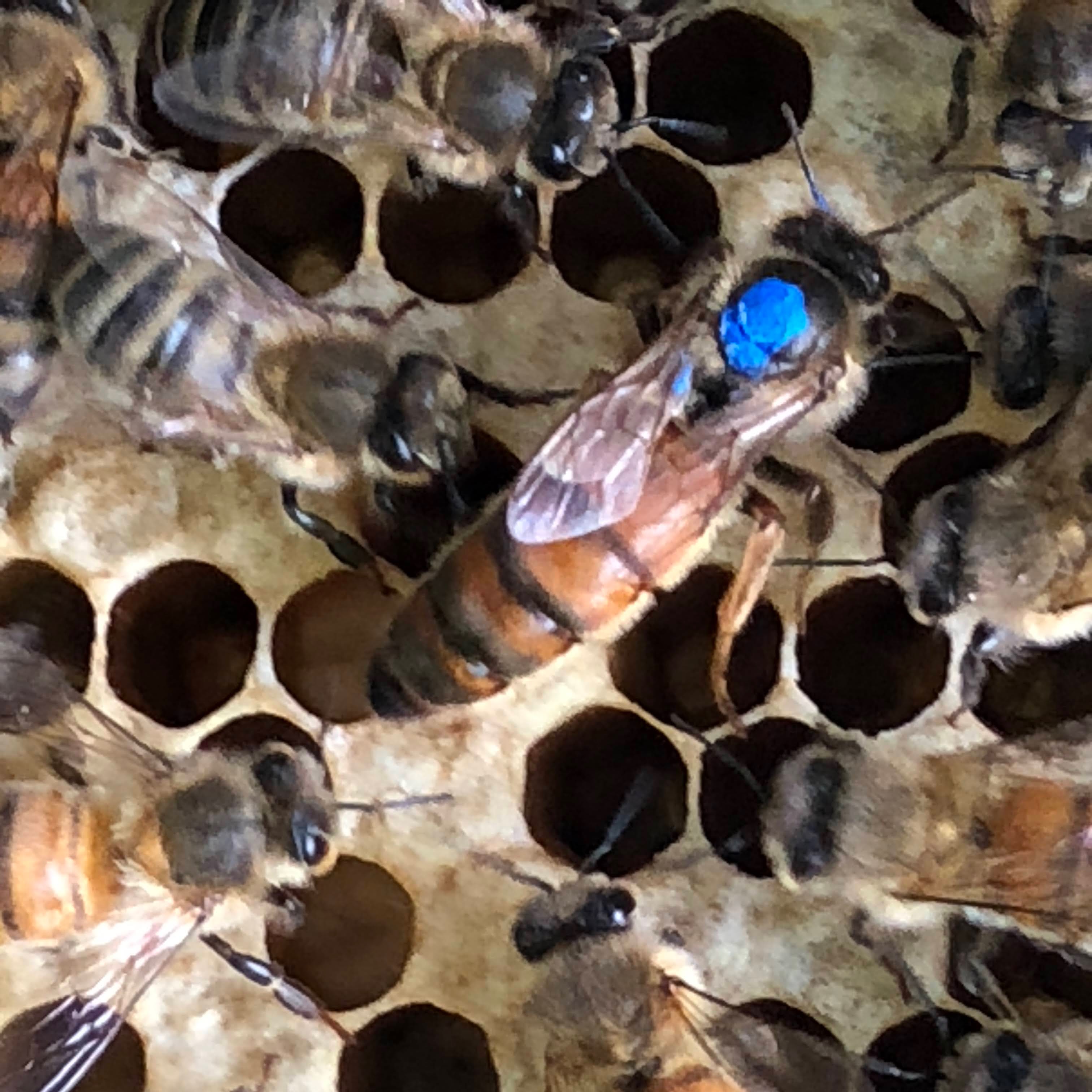
Sunday, 3 October 2021
Say Hello To Sir Stingalot
Sunday, 1 August 2021
Introducing... Queen Philippa!
Every beehive has a single queen bee, and the queen in hive #2 is called Philippa. She is named after Philippa Foot, who was a philosopher and one of the founders of virtue ethics.
Philippa Foot attended Somerville College, Oxford from 1939–1942, where she obtained a first-class degree in philosophy, politics, and economics. After a five year spell spent as a government economist, she took up the post of lecturer in philosophy at Somerville College in 1947. Philippa spent the remainder of her career at Somerville, becoming a senior research fellow in 1969 and honorary fellow in 1988. She also held a number of visiting professorships in the United States.
Philippa is best known for devising, along with Judith Jarvis Thomson, the thought experiment popularly known as the "trolley problem". This considers the scenario where a runaway trolley is careering down the tracks towards five people. If it continues on its present course, it will run into them and kill them. You have control of a set of points; if you pull the lever, the trolley will be diverted onto a side-track. However, there is one person on the side track who will be killed if the trolley is diverted onto it. Which is the more moral choice?
Philippa was one of the founders of contemporary virtue ethics, and she spent much of her career considering questions such as "Why be moral?" She was inspired by, and developed upon the ethics of Aristotle, and critiqued ideas including consequentialism and non-cognitivism.
You can find out more about Philippa Foot here: https://en.wikipedia.org/wiki/Philippa_Foot
Here is a photograph of her namesake, queen Philippa:
Sunday, 11 July 2021
Introducing... Queen Christina!
Every beehive has a single queen bee, and the queen in hive #1 is called Christina. She is named after Christina Rossetti, who was a nineteenth century poet and was associated with the Pre-Raphaelite Brotherhood.
Christina Rossetti was born on 5 December 1830 in London. Her father Gabriele was a political exile from Abruzzo (now part of Italy). Her mother was Frances Polidori, the sister of Lord Byron's friend and physician, John William Polidori. She had two brothers and a sister; her elder brother was the Pre-Raphaelite artist Dante Gabriel Rossetti.
Christina began writing poems in 1842, and later experimented with sonnets, hymns and ballads. She was 18 years old when her first two poems were published: "Death's Chill Between" and "Heart's Chill Between". In 1862 she published "Goblin Market and Other Poems", which was critically well-received and established Christina's reputation as a leading female poet. "Goblin Market" in particular has come to be one of her best known; it has been interpreted in a variety of ways and has attracted much attention from literary critics. Christina also wrote the words to the Christmas carol "In the Bleak Midwinter".
She continued to publish throughout her life, including further collections of poems and short stories, and six volumes of devotional prose.
You can find out more about Christina Rosetti here: https://www.poetryfoundation.org/poets/christina-rossetti
Here is a photograph of her namesake, queen Christina:
Saturday, 19 June 2021
Meet The Queens
I opened up the hives last weekend, as I wanted to see how the bees were getting on with building comb, and also wanted to check if I had queens - and if they were laying. Yes, and yes! - here's the queen of hive #1 (the mystery swarm):
And this is the queen of hive #2 (the swarm I collected):
Interestingly, the queens (and their bees) are quite different. Queen #1 is a mid-amber colour with very thin dark bands, and so are her bees. I would guess from their coloration that they are descended from Italian honey bees (Apis mellifera ligustica). Queen #2 is a little darker, with wider black bands, and her bees are much darker with very wide black bands. They are Apis mellifera mellifera, the north European honey bee. I wonder if I will see distinctly different behaviour from the two colonies?
As for comb building, this is what they'd done with the small piece of comb that I wired into a frame the previous week:
Both colonies had drawn 5 frames of wax (i.e. half the brood box). Here's hive #2 with one (drawn) frame removed, so you can see their progress:
All looking good so far, so the next task will be to mark the queens. Regular readers will know that I name my queens when I mark them, so I will have to decide on new names. My previous bloodline (all descended from my first queen, Rosalind) were all named after scientists and engineers. This time, I might look at a different discipline - or possibly two separate naming schemes, one for each bloodline. That will probably be a task for this weekend.
Monday, 31 May 2021
New Bees! - Part 2
So, last time I collected a swarm, and just as I was finishing up I noticed that my box of spares had got out of alignment - and some bees were now hanging around the unplanned entrance:
I had a closer look, and there was indeed a gap at the bottom of the one of the boxes, wide enough to let bees in and out:
There were some previously-used honey frames in the stack, and I wondered whether the bees had smelled the wax and had popped in to see whether there was still any old honey in the comb that they could steal for an easy meal. I thought I'd better take a look, so I took the roof off, and carefully lifted the crown-board for a better look. Well, this was a surprise:
Yes, that is a swarm of bees! They'd clearly decided to ignore the two fully-furnished 'bait' hives that I'd left open and available, and had instead chosen to spurn the designer residence option and opt for a 'doer-upper' instead. As you can see, they'd already started making themselves right at home by building some new comb, which they'd attached to the underside of the crown board.
That was Friday morning, and I really needed to get back to work. So I carefully closed up and left them to it.
On Saturday I had plenty of time, and some fair weather, so I collected everything I might need (bee jacket, smoker, two hive tools and secateurs, as well as some waxed and unwaxed frames) and headed back to see if I could sort it all out. The first job was to open up one of the hives, and take all the frames out so that I had an empty brood box to start moving the bees into.
The next task was to shake the bees off the crown-board and into the hive. That left the new comb exposed - which I didn't want to waste, as the bees have worked so hard to make it (it takes around 10 millilitres of honey to make 1 gram of wax, so it's an expensive business for the bees to produce it). I carefully cut the two pieces of new comb off the crown-board, with the idea that I might be able to re-use them.
I had to improvise, so I picked some foundation wire out of one of the waxed frames, snipped it off with the secateurs, and used it to attach the two pieces to an unwaxed frame. This new frame then went into the brood box, and hopefully the bees will re-attach the comb properly to the top of the frame:
There were still plenty of bees (maybe half the swarm?) in the stack of spare boxes. So the next job was to move the rest of the boxes in the stack over to the hive, on top of the brood box, and let the bees slowly make their way down:
And then take the boxes off, one at a time...:
... until all the bees were in the brood box. You can see from the the following picture how many bees were outside the hive - imagine how many there are inside!
Finally, stack the outer wall ('lifts'):
Put the roof on - and we're done!
So, that's now two swarms successfully hived in one weekend! I'm pleased (and surprised) that I didn't get a single sting while doing any of this. Both colonies seem to be pretty gentle and good-natured, so I'm hoping that means I'm going to have a pleasant and relaxing summer of beekeeping.
Sunday, 30 May 2021
New Bees!
Yes, it's absolutely true - on Friday morning I got a text from fellow Bath Rugby fan Mark, to say that his neighbour had a swarm in the hedge in his front garden. This, obviously, was too good an opportunity to miss, so I grabbed a bee jacket, nucleus and secateurs, and headed over.
Well, he was absolutely right - a lovely sized swarm, nicely located at waist height in a cotoneaster bush. Mark was happy to take photos while I got to work:
With the nucleus in place below the swarm ball, I grabbed the secateurs and started cutting:
Here are the bees after I'd shaken them off the branch and into the nucleus:
Put the frames in:
Roof on, and wait for the stragglers to walk down into the entrance:
Then I closed the entrance block, popped them into the boot of the car, and drove up to the apiary to place them in their new home. And here they are - happy, and flying about:
So the happy news is that I now have bees, and The Southdown Apiary is now a proper apiary! I must admit I was feeling pretty pleased with myself now that I've caught a swarm and can call myself a beekeeper again.
I have the apiary laid out so that the hives are on one side, and the stack of spare boxes (spare supers and frames) on the other, with the nucleuses (nuclei?) at the far end. So, satisfied after a successful swarm collection, I was walking back out of the apiary past the 'spares' stack, when I noticed the boxes were out of alignment:
My guess is Joel's dog, Iris, had been sniffing around and had knocked the boxes slightly out of kilter. But then I noticed some bees buzzing around one of the mis-aligned corners. I wonder...
Friday, 30 April 2021
Welcome to The Southdown Apiary!
The hives are moved, the website is re-directed, there is a new - albeit temporary - logo, and I have a shiny new email alert service - welcome to The Southdown Apiary! (Which, if you hadn't already worked it out, is the blog formerly known as Beechen Bees). I have everything I need for an exciting year's beekeeping... except... no actual bees. Yet. But swarm season is almost upon us, so I am somewhat optimistic that will get sorted out fairly soon.
| The hives are ready - we just need some bees! |