Wednesday, 14 June 2023

And Another One!

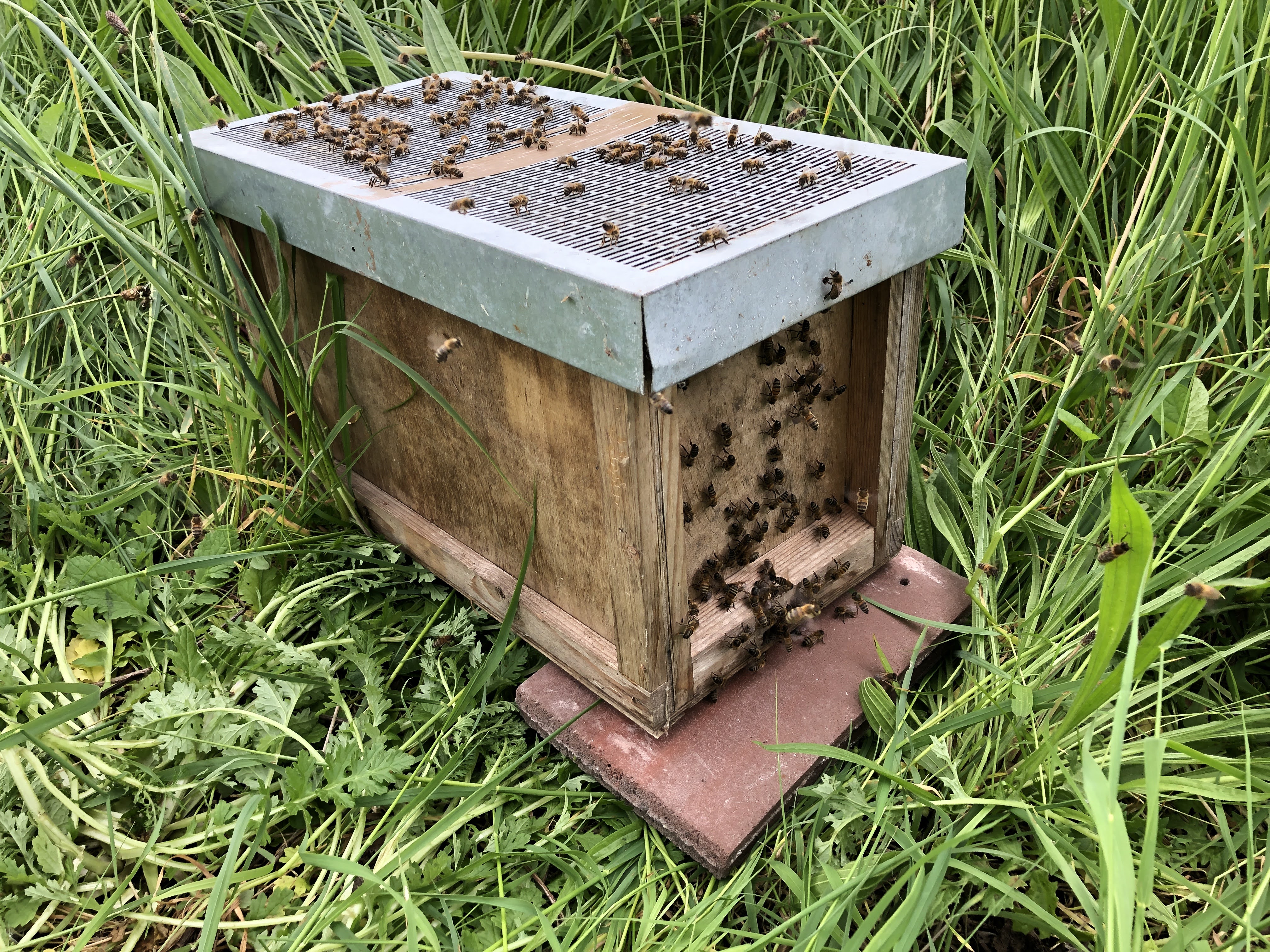
A couple of Fridays ago, I got a call from local bee enthusiast Gerry (who was involved in the previous post's shenanigans) letting me know about another swarm.  This time, it was a small-ish swarm, around shoulder height, in a small fir tree at the crazy golf course in Victoria Park:

This looked like a nice easy one - and since Gerry and I had just had practice with the previous swarm, we were feeling pretty confident.  Everything started well - the whole swarm dropped easily into Gerry's bucket when I shook the branch, and they all went into the nucleus in one go.

But, that was when it all started to get a bit more complicated.  As you can see from the photo above, there were quite a lot of bees on top of the nucleus, and airborne in front of it.  We watched for a few minutes, hoping they would settle down.  Instead, the opposite happened - and bees started walking out of the nucleus and gathering at the front:

This looked like a problem - when bees do this, it usually means they are about to re-swarm.  Gerry and I discussed what to do, but the reality is, when this starts to happen, there is almost nothing you can do to stop it.  Your only chance is to find the queen, and somehow keep her in the nucleus.  But, really, what are the chances of spotting a queen among a swarm of 10,000 bees?

And that's when I watched the queen walk right out of the front of the nucleus.

I had to act fast.  The next conversation went something like this:

"That's the queen Gerry - I can see her, right there on the front of the nuc.  What do I do?  Do I grab her?"

"Yeah, I think you need to pick her up."

"Yeah - I think you're right.  OK.  I'm doing it."

And with that, I reached towards the front of the nuc, aimed a finger and thumb at the queen... and missed.  You pick up a queen bee by her wings, and it's not the most difficult thing to do, but I'm a clumsy oaf.  The thing is, if you miss once, she'll usually wiggle about a bit, and you have to hope she stays pointing in roughly the right direction (if you're right-handed, it's easiest if she's facing up and to the left).  If you miss twice, she'll get spooked and start haring off and you'll never catch her.  So I basically had one more shot.  I leaned in, breathed in, hovered a finger and thumb over her...

And got her!

This was great - now all I needed was something to put her in.  A matchbox would have been ideal.  Or my queen cage, which I'd foolishly left locked in the car.  Gerry had a quick chat with the chaps who ran the crazy golf, who went to have a rummage in their shed.  it felt like I was standing there for ever, holding onto this little insect who desperately wanted to wriggle free.  And trying not to hold on too tight, for fear of damaging her wings.  And then they came back, with an empty box that they used to keep their allen keys in.  It was good enough - I flipped open the flap, popped her inside, closed it up and put some gaffer tape on to make sure she couldn't escape.

The next problem was making sure all the other bees knew where she was.  They keep track of the queen via pheromones, which were of course now all circulating inside the box.  So, back to the shed to get a large screw, which I used to make some holes in the box.  And then I carefully placed the queen-in-a-box into the nucleus, and hoped the bees would be able to pick up the scent of her pheromones.

In case you are wondering, none of this is by-the-book swarm collection.  It was pretty much a combination of amateur hour, and making it up as we went along.  But, amazingly, it worked.  The bees picked up the scent, calmed down, and started heading back into the nucleus.  All was looking fine.  Until Gerry asked the obvious question:

"How are you going to get her out at the other end?"

Yeah.  I hadn't thought of that.  This was when my queen cage (now retrieved from the car) was going to come in useful.  It's basically a cylinder with a plunger, that looks like this:

If we could transfer the queen into the cage, and put that into the nucleus, then releasing the queen at the other end would be as easy as pulling the plunger.  But first we had to get the queen out of the box and into the cage.

Gerry devised a plan where we would cut the top of the box on three sides, peel back the flap and then put the cage over the queen.  So, back to the shed for a razor blade, and then we took the box out of the nucleus and I knelt down next to Gerry while he started cutting.  I was hoping he wouldn't slice through the queen...

Gerry told me he was ready, pulled back the flap (and got a sting for his efforts) and... no queen.  Well, not that we could see - the problem was, lots of bees had followed the pheromone trail, so the area where we'd been cutting the box now looked like this:

I felt I had no choice - I was going to have to put the open box back into the nucleus, and hope for the best.  I was just about to place it back, when the queen walked out and stood herself right in the middle of the bottom of the box.  This time there was no need to pick her up - I still had the queen cage in my other hand, so I carefully placed it over her, made sure she was at the far end of the cylinder and pushed the plunger half an inch in.  Now that she was secure, I put the queen cage into the nucleus, put the roof on, and waited.  After about half an hour, things were much more calm.

That was the hard part over, and after another half an hour I closed up the entrance, took the bees back to the apiary and put them in the hive.  Not a textbook swarm collection by any means, but at least I now have two full beehives again, which I'm really pleased about.  Neither of the queens have names yet, but that will probably be the subject of the next post.

Friday, 19 May 2023

Out With The Old... In With The New

April was cold, wet and just not good for beekeeping.  So I had to wait through most of the month before I could actually check my hives for the first time.  On the last Saturday, the weather was finally warm and dry enough to open up, so I headed over to the apiary, feeling cautiously excited to see what lay in store.  Unfortunately, it was pretty bad news.  Both hives and the nucleus looked like this:

That is, sadly, a cluster of dead bees.  So, all three colonies have perished.  What killed them?  I can't say for sure - maybe it was a virus, maybe the cold and damp weather, perhaps a combination of the two, or something else entirely.  Whatever the reason, this is sadly the end for queens Christina, Philippa and Henrietta.  Unfortunately, there is only one thing to be done - all the brood frames have to be burned.

There is some honey in the hives.  Some of it has started to ferment, and so won't be consumable.  But some I think is still sealed and could well be extracted and put into jars.  I'm going to have a look tomorrow and see what I can rescue.  As for the honey that has started to ferment... I'm wondering if this is the year when I finally have a go at making mead?  At least it will be something to cheer myself up after losing all my bees.

However... all is not lost.  On Wednesday, I got a call from fellow local beekeeper Gerry, who saw this hanging from a tree opposite his house:

That is a swarm - a big one, too!  Gerry already has his apiary fully stocked, so he was kind enough to offer me first dibs on the bees - and I of course jumped at the chance!  Luckily, the swarm was on a nice flexible branch at head height, so Gerry held a large bucket underneath while I gave the the branch a quick shake, and the whole swarm dropped into the bucket.  It was a textbook swarm collection.  Gerry had a spare nucleus, so he tipped the bees in and put the roof on, and then we waited for them to settle.

After about an hour they had all settled down, and the remaining airborne bees had all made their way into the nucleus.  So I placed them (carefully!) into the car, and drove the short distance up to the apiary, where I had some spare frames ready to pop inside.  This was the point I realised just what a big swarm it was - it took some time to carefully slide the new frames in between the thousands of bees:

So that is where we are so far - all my old bees are gone, but I'm in a great position to get back started again this year.  I'm planning to go to the apiary tomorrow, rescue what harvestable honey I can, and then move the bees into one of the hives.  Once that's done, the new beekeeping year should be properly under way.

Tuesday, 20 December 2022

Market Day

Saturday was a first for The Southdown Apiary, as I got to set up my very own stall as part of the Bear Flat Community Market & CafĂ©.  Mrs Beekeeper and I headed down early doors to carry in the stock and get set up:

It was a really fun morning, as I got to meet some new people in the community, talk about my bees and honey, and sell a few jars.  Huge thanks to the Bear Flat Association and Helen, Judith and Joy for booking me a table, and for all the work they do in organising the market every month.

The good news is there are still some jars left, and I'm hoping to have a table at the next one on 21st January (9.30am – 12.30pm).  So if you're a Bath resident (or visiting), please do pop in and say hello!

Monday, 26 September 2022

Introducing... Queen Henrietta!

Science warning: this post contains actual science. You have been warned...

Every beehive has a single queen bee, and the queen in hive #1 is called Henrietta. She is named after Henrietta Swan Leavitt, who was an astronomer who changed the way we measure the size of the universe.

Henrietta Swan Leavitt was born in Massachusetts, and attended college in Ohio before transferring to Massachusetts' Society for the Collegiate Instruction of Women (later Radcliffe College).  In her fourth year, she studied astronomy, as well as working as a 'computer' at the Harvard College Observatory where she measured and catalogued the brightness of stars from photographic plates.

After finishing college, Henrietta spent some time travelling in Europe before returning to the Harvard College Observatory in 1903.  Working under director Edward Charles Pickering, Henrietta began studying variable stars (stars which oscillate between brighter and dimmer luminosity - also known as 'Cepheid variables') in the Small and Large Magellanic Clouds.  She published her analysis of 1,777 variable stars in 1908, and found that brighter variables had a longer period - in other words, if the variable star is brighter, the length of time between maximum and minimum luminosity is longer.

Building on her earlier work, in 1912 Henrietta published a new paper based on a sample of 25 variable stars in the Small Magellanic Cloud.  In this new paper, Henrietta established that there was a direct relationship between a variable star's brightness and period.  If you look at figure 2 on page 3 of the 1912 paper, there's a really nice graph showing the linear relationship between the magnitude and (logarithm of the) period of the stars, with the upper line showing the maximum brightness, and the lower line the minimum brightness.

Henrietta reasoned that, because all 25 stars in her sample were in the same galaxy, they were all roughly the same distance from Earth.  This meant that the logarithm of the period was related to the intrinsic brightness of the star.  Which further meant that, if you had two variable starts with the same period, but one appeared dimmer than the other from Earth, then the dimmer one must be further away, and the difference in distance would be directly related to the difference in brightness.  There was only one problem - at the time, there was no method to determine the distance to the Small Magellanic Cloud, and therefore no way to calibrate absolute distance based on Henrietta's 25 stars.

Fortunately, a year later, Danish astronomer Ejnar Hertzsprung measured some much closer cepheid variables using the parallax method (basically a fancy version of Pythagoras's theorem, based on the earth's orbit).  He was then able to use Henrietta's work to calculate the distance to the Small Magellanic Cloud.  (Oddly, his initial calculations had the Small Magellanic Cloud 10 times closer than it actually is, but the error was soon corrected).

Before Henrietta's work, the parallax method was the best available technique for measuring distance in the universe, but was only accurate up to a few hundred light years.  Henrietta's ground-breaking analysis expanded the accurate measurement of astronomical distances up to about 20 million light years.  She quite literally expanded the frontier of human understanding of the universe.

You can find out more about Henrietta Swan Leavitt here: https://en.wikipedia.org/wiki/Henrietta_Swan_Leavitt

Here is a photograph of her namesake, queen Henrietta:

Saturday, 10 September 2022

It's Harvest Time!

Apologies I've taken so long to provide any updates - this was due to a change in email platforms, which was a bit complex to sort out.  Email notifications are now fixed (hooray!) so I can share the good news about this year's honey harvest:

Note the re-brand - fancy new honey labels designed by Mrs Beekeeper!  It's been a bumper crop this year - actually, my best ever.  Totals for each hive were as follows:

  • Hive #1 - 60 jars
  • Hive #2 - 46 jars
That's a whopping 106 jars, which I am very pleased about.

It's been a fairly straightforward beekeeping year, without any real dramas - the bees have been very busy, and don't seem to have had any time for any shenanigans.  One change - back in June, Christina (formerly of hive #1) was moved into her 'retirement home' in the nucleus, to prevent her from swarming.  Hive #1 then made some queen cells, which I thinned down to one, and the new queen hatched at the end of June.  I have yet to get a photograph of her, but hopefully that will be coming soon.  And of course, she will need a new name.  So, more to come about the new queen of hive #1 later this month.

Sunday, 3 October 2021

Say Hello To Sir Stingalot


Each of those small, pale dots on my jeans is a bee sting.  I decided to start the process of taking the honey off hive #1 this morning, and - as you can probably guess from the number of stings in the photo - it did not go well.  In case you're wondering - yes, they were specifically targeting my groin area.  They may be small, but they know how to hit where it hurts...

I was hoping that there wouldn't be too many bees in the super (the box with the honey frames) and that I might be able to simply shake the bees off and then take the super away with me today.  Well, that wasn't an option, as there were lots of bees.

So, I had to go with the slower option.  Basically, it goes like this:  Firstly, you temporarily remove the full super (i.e. full of honey and bees) from the hive.  Then you put a couple of these little devices, called 'porter bee escapes' into the slots on the crown board:


The way they work is they are one-way gates, which allow the bees down through the hole (in the one on the left) and then out through the slots that you can see at the top and bottom of the one on the right.  Here's what they look like in place (not my own crown board, as taking photos today was... challenging...):


You then put the crown board back on the hive, with the super on top.  The idea is that, throughout today, the bees will travel down, through the porter bee escapes, out of the super and into the hive below - and won't be able to travel back up again.  Which means that, in theory, when I go back to the hive tomorrow morning, there won't be any bees in the super, and I will simply be able to take it off the hive and bring it back to my house to extract the honey.

So, I will be up early tomorrow at the hive to see if the theory works in practice.

Sunday, 1 August 2021

Introducing... Queen Philippa!

Every beehive has a single queen bee, and the queen in hive #2 is called Philippa. She is named after Philippa Foot, who was a philosopher and one of the founders of virtue ethics.

Philippa Foot attended Somerville College, Oxford from 1939–1942, where she obtained a first-class degree in philosophy, politics, and economics.  After a five year spell spent as a government economist, she took up the post of lecturer in philosophy at Somerville College in 1947.  Philippa spent the remainder of her career at Somerville, becoming a senior research fellow in 1969 and honorary fellow in 1988.  She also held a number of visiting professorships in the United States.

Philippa is best known for devising, along with Judith Jarvis Thomson, the thought experiment popularly known as the "trolley problem".  This considers the scenario where a runaway trolley is careering down the tracks towards five people.  If it continues on its present course, it will run into them and kill them.  You have control of a set of points; if you pull the lever, the trolley will be diverted onto a side-track.  However, there is one person on the side track who will be killed if the trolley is diverted onto it.  Which is the more moral choice?

Philippa was one of the founders of contemporary virtue ethics, and she spent much of her career considering questions such as "Why be moral?"  She was inspired by, and developed upon the ethics of Aristotle, and critiqued ideas including consequentialism and non-cognitivism.

You can find out more about Philippa Foot here: https://en.wikipedia.org/wiki/Philippa_Foot

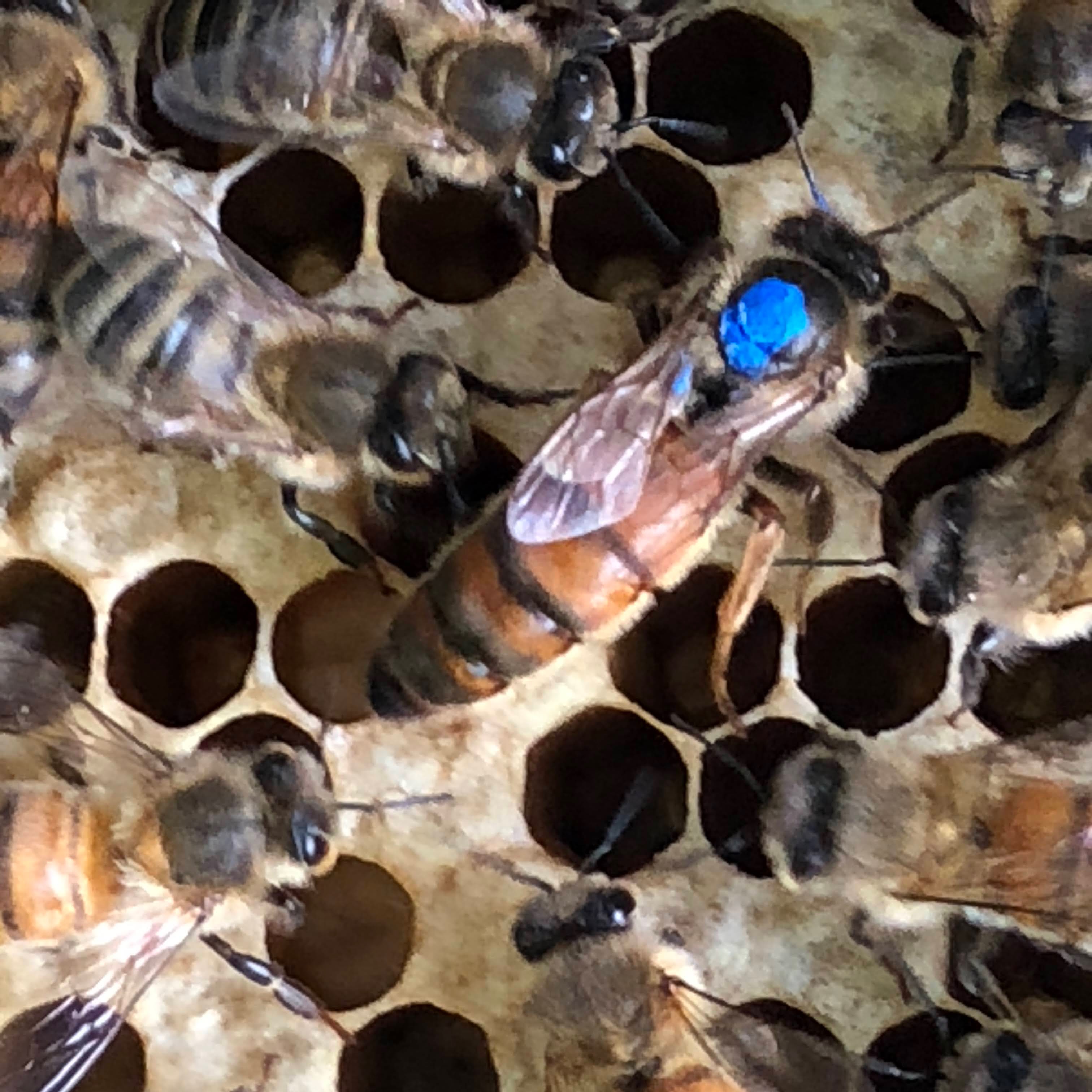
Here is a photograph of her namesake, queen Philippa: