Saturday, 31 December 2016

Review of the Year 2016

Firstly, I hope you all had a super Christmas.  I have received some new hive parts as presents (thank you Mrs H and Mrs C!) which I shall have fun putting together before spring, ready for next season's activity.

So, it's that time of year when we all look back before we look forward, and I thought I'd join in the fun.  How have the bees been this year?

Short answer - well!  Slightly longer answer - Miriam's bees in hive #1 have done very well (39 lbs of honey is a personal record) and hive #2 is in great shape under Caroline, having had a difficult start to the year under previous queen Florence (RIP).

So, what's gone well, and why?  And more importantly, what have I learned?

Firstly, bees notice when you do stuff.  Actually, I knew this already - the whole hive is a delicate balance of hormone feedback pathways, and if you upset the balance, it fundamentally changes the bees' behaviour.  So it was with Florence's hive - back in May, I decided to start swapping out brood frames (with larvae and pupae) from Florence's hive to Miriam's.  This was great news for Miriam's hive, which built up numbers very quickly.  But for Florence, it meant not enough brood - and the bees knew it.  What they didn't know (how could they?) is that it was my fault.  So they mis-identified the culprit as Florence, and mis-diagnosed the problem as her failing to lay enough eggs.  Bees have a pretty unforgiving attitude to under-performing queens - so they executed her.  Ouch.

Fortunately, they also have the means to create a new queen when required, so a bit of jiggery-pokery later, and they were back up and running with new Queen Caroline.

Queen Caroline!

Next up - comb changes.  I like to change the brood comb every year, as this prevents viruses, fungi and other pathogens building up in the wax.  I was always taught to do it in April, as soon as possible after the first inspection.  The problem was that, this year, I simply couldn't, for two reasons:  Firstly, the weather was really cold until May, so I really couldn't open the hives up during most of April.  And when I did, both colonies were too small - there simply weren't enough worker bees to make any significant amount of wax comb.  So I had to wait.

The moment of realisation came just after I'd taken the honey off Miriam's hive in the middle of August.  The colony size was at its peak (around 60,000 bees) yet I'd just halved the size of the hive.  There were too many bees, and nothing for them to do.  The answer?  Give them 11 new frames, and get them to work building wax!  The results were fantastic - I've never known them to build comb so quickly.  So the big learning point was this:  Don't get the bees to build comb in the spring when they've got a load of other tasks to do - get them to do it straight after harvest when their season's work is done and they have loads of spare workers.  This is going to be part of their annual schedule from now on.

A lot of bees...

The next thing that went well - I actually sold some honey!  For the first year ever, Beechen Bees honey has been available to buy on the high street.  Specifically, in The Deli, Widcombe - about 200 yards from the hives.  Big thanks to Nicky and everyone else for such a great job of marketing and selling my honey - really looking forward to doing it again next year!

Gift Pack - Beechen Bees Honey and Honey's Midford Cider - delicious!

Winter preparation:  I think my bees were in the best shape ever, going into Winter.  Miriam's colony already had all the honey they needed, so there was no need to feed them at all.  Caroline's needed some feeding, as they had lost a lot of time with the change of queen, and the consequent impact on colony size.  Luckily, Autumn was warm with plenty of good forage (ivy and bramble in particular) so they built up numbers well through September.  By the time I set the hives in their winter configuration, they both had plenty of bees and honey and were all set to hunker down for the colder weather.

Winter prep - icing sugar encourages grooming, to remove parasites

The last big change was the conversion to a different hive design - the WBC.  This double-walled hive should help with temperature regulation in the hives, and also assist in keeping them dry inside, which matters down here in Somerset where the climate is often damper than in London, where I started beekeeping.

Double-walled WBC hives all ready for winter

... and I should of course mention the blue, black and white paint job on the new hive outer walls, which has brought a resurgence in form to the mighty Bath rugby team!  It must be working, 'cos we're currently 3rd in the Premiership...

So here's looking forward to 2017, with hopefully more bees, more honey, and more wins for our boys in Bath!

Tuesday, 18 October 2016

Mouse-Proofing

Pretty much the very last task of the beekeeping year is mouse-proofing the hives.  Surprisingly, mice quite like to nest in beehives during winter, because it's nice and warm, and there is plenty of food (i.e. honey and wax) for them to eat.  Personally, I'd rather not snuggle down with 10,000 stingy insects, but mice are apparently prepared to take the risk.  Actually, once the weather gets cold the bees won't be moving round very much, so if the mouse finds a cosy corner it will probably get through the winter undisturbed.

There are certainly mice around - our cat, Patsy brings us the proof, from time to time!  And if a mouse got into one of my hives, it would almost certainly be the end of the colony, as it would eat too much of the bees' precious stores of honey.

So, I need to put a device called a "mouse-guard" (beekeepers are very utilitarian in their terms) onto the front of the hive.  It's basically a perforated metal strip, with each of the holes large enough to allow a bee through.  The ones I'm putting on the hive today look like this:


The design of the WBC Hive is very convenient, because it allows for the mouse guards to be inserted into the porch, and held in place by the sliding blocks that are normally used to control the size of the entrance.  It's easier to show it in a couple of photos:


So, with the mouse-guards in place, the bees are well-protected as they start to bed down for the winter.  The mice will just have to find somewhere else to make their nests!

Thursday, 13 October 2016

Asian Hornet - Update

The good news - the Asian Hornet found near Tetbury has been tracked back to its nest, and the nest has been destroyed.  The bad news - another confirmed sighting north of the Mendip Hills at the beginning of October (and the nest not found, yet).  This puts Bath pretty much between the two confirmed sightings.

So, it's time to take some action.  I'm going to make a trap.  DEFRA and the National Bee Unit have helpfully provided instructions for constructing a home-made Asian Hornet trap out of two 2-litre fizzy drinks bottles, steel mesh and some wire.  I have my kit ready:


So, all I have to do is finish drinking the lemonade, and get busy!

Hopefully, there aren't any more Asian Hornets and my trap will stay empty.  But if I do get one, then it will need to go off to DEFRA for confirmation and analysis.  Fingers crossed it won't come to that...

Sunday, 25 September 2016

And So To Bed...

It's the last weekend in September, and that means the last beekeeping day of the year.  There were only three things to do, in this order:
  1. Check that both hives have enough honey stored for winter.  Yes, they do - so I can stop feeding Caroline's bees now.
     
  2. Change the hive configuration.  Normally, the super (the box with the honey frames, but no brood) goes above the queen excluder, which is above the brood box (where the queen lays all the eggs).  In winter, I put the super underneath the brood box, and remove the queen excluder - allowing the queen, and the rest of the colony to roam freely.  The idea behind this is that the bees will generally form the cluster at the bottom of the hive (in the super) and then work their way upwards - to the brood box - as winter progresses.  This means they will be in the brood box when spring comes around, which keeps things nice and tidy for me.  Actually, not all beekeepers do this, but it's how I was taught, and it's served me and the bees well so far.

    There are a lot of bees in each hive at the moment, and there's a lot of honey on the frames - making the boxes pretty heavy.  So, this was going to be a two person job.  Luckily, my friend Fi was visiting this weekend and was on hand to help.  Unluckily, she got stung (twice) while helping me move the boxes around.  Well, that's bees for you...  (Sorry, Fi!)
     
  3. Finally, sprinkle some icing sugar onto the brood frames.  Here's Fi doing just that:


    The reason for doing this is it gets on the bees, which then groom each other to remove the icing sugar.  As they do so, they are more likely to find varroa mites, and remove them too.  So it acts as a natural stimulant to the bees' normal grooming behaviour.  I haven't used any chemical controls in either hive this year (though doing the comb change in Miriam's hive will have helped to lower the number of varroa in the hive).  So hopefully this will help a bit in reducing the mite level - which is important, as I don't want the hives carrying too many mites over winter.  Too many mites increases the risk that the colony won't survive, and I want to keep the risk down if I can.

    Normally I will actually pull the frames out and sprinkle the icing sugar onto the surface of the comb, but we were a little short of time and it was starting to get cold, so I decided to just sprinkle the top of the frames.  Hopefully it will still do some good.

And that's it - beekeeping done for another year.  I still have odd bits of maintenance to do over winter though:
  • I need to make some more lifts for the outer walls of the hive, as I haven't enough if both hives make a lot of honey next summer
     
  • I'd like to replace a couple of the supers with new boxes
     
  • I need to make up some new brood frames, so that I am ready to do Caroline's comb change in the spring

Other than that, I just have to wait until the first warm weekend in April.  I'll probably be posting a bit less frequently over the winter, though I do have a couple of articles planned, including one on drones, and also some info about propolis.

I think I've prepared the hives as well as I can, and they seem to be in pretty good shape for surviving the winter.  But I will still be keeping my fingers crossed until that first sunny spring day...

Thursday, 22 September 2016

Asian Hornet - Bad News for Bees

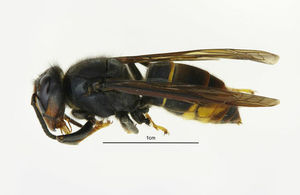
Worrying news from Gloucestershire - DEFRA have confirmed the first verified sighting of the Asian Hornet in Tetbury.  That's only 25 miles from here - a little close for comfort.

This is what they look like:


Asian hornets are predators that hunt honey bees, and can pose a risk to colonies - they are capable of killing a weaker colony.

DEFRA have more info here:
http://www.gov.uk/government/news/asian-hornet-identified-in-gloucestershire

Monday, 19 September 2016

Feeding for Winter

Regular readers will know that Miriam's bees made plenty of honey this year - and I have left her colony with enough of their own honey for them to have plenty of stores to make it through winter.

But Caroline's bees?  Not so much.  With all the shenanigans of the execution of Florence, and then failing to replace her, they just haven't had the time or the numbers to store much honey.  Unless they get some, they'll run out and starve before spring.  What to do?  Well, feed them, of course!

You'd think that, with all the excess honey Miriam generated, I could just feed that to Caroline's bees.  But you'd be wrong.  Feeding bees honey from another colony can be bad - there is a real risk of disease transfer (not diseases that humans can get - we're perfectly safe.  But there is a risk of transferring American Foul Brood spores, and other nasties).  Actually, the easiest thing is sugar syrup.  Basically, I mix up 1kg of sugar (ordinary white granulated sugar - never brown sugar) with ¾ of a litre of hot water, and then let it cool.

So, once I've got my syrup, how to give it to the bees?  The answer is to use a feeder bowl, which looks like this:


This is basically a covered bowl with a funnel in the middle, and the bees climb up the inside of the funnel and then over to the other side, where they can get to the syrup.  It's easier to see with the lid off:


There's a clear plastic cup over the funnel, which stops the bees floating off into the syrup and drowning.  And at the bottom, I can see some bees trying to get at the last drops of syrup.  In case you've ever wondered, this is what a bee's tongue looks like:


OK, they're hungry - time to fill up the bowl:


As you can see, when I fill the bowl they cluster at the surface of the liquid where they will fill their stomachs with syrup.  They then head back down the funnel into the hive, where they will regurgitate the syrup into cells in the comb so it can be stored for winter.

They have an astonishing appetite too - Caroline's bees are currently taking down 1½ litres of sugar syrup every day!

Friday, 9 September 2016

Farewell to Queen Sarah

Don't panic - nothing bad has happened to Queen Sarah, and her colony in the nucleus.  I was recently speaking to Steve, another local beekeeper, who had sadly had his bees wiped out by wasps (have I mentioned that wasps are evil?)

I mentioned that I had the colony in the nucleus, and would he be interested in putting them into his (now vacant) hive?  Indeed he would!

This is good news - I have over-wintered bees in the nucleus before, but I prefer the extra storage space (for storing extra honey) that a hive provides, as it reduces the risk of the bees running out of honey stores in the winter.  So moving Sarah's colony to Steve's full-size hive gives them the best chance of making it through winter - and Steve gets to be a beekeeper again.  Everybody wins!

On Tuesday evening, Steve and I met at the apiary at dusk, secured the nucleus (gaffer tape was involved) and loaded it into Steve's car, ready for him to move the bees into his hive the following day.  If you're wondering why we met at dusk, it's because we needed to wait until all the foraging bees had returned to the hive - otherwise some very confused bees would be wondering where their home had suddenly disappeared to!

So here's a final look at Queen Sarah's colony, and I hope they have a prosperous future: