Wednesday, 21 March 2018

It's Spring!

Yesterday was the vernal equinox, which means that from today the days are longer than the nights.  So it's spring, and that means beekeeping!

Actually, there was only one job today - but an important one - remove the mouse guards from the hives.  The bees are starting to bring in pollen from the early flowering trees (blackthorn and cherry), and I don't want them to accidentally knock it off their legs as they pass through the small-ish holes in the mouse guards.  So, the mouse guards have been duly removed.  Here's a quick before-and-after:

Before...
... and after!

I also had a chance to pop over to Sydney Buildings to take a look at the new ZEST hive.  Here's a picture of it with the roof off, and all the new frames:


... And with the roof on:


We just need to get some bees in there, now!  I have a plan for that...

Thursday, 15 March 2018

What's a ZEST Hive?

If you read my recent(ish) review of the year, you may have spotted that I've been chatting to some neighbours in Sydney Buildings who want to get started with beekeeping in the spring.  We've met up a couple of times to discuss various things for when they get started.  One of the options is which hive design to go for.

Regular readers will be aware that when I started beekeeping, I used the British National hive design.  And that, a couple of years ago, I converted my hives to the WBC design.  Well, there are actually plenty of other hive designs around, including:
  • The Commercial hive
  • Langstroth hive
  • Smith hive
  • Dadant hive
  • Dartington long hive
  • Warre hive
  • Top Bar hive
These are all wooden hives, but vary in the shape of the boxes, the way the honey frames are added (either sideways, or "upwards") and whether comb is built in frames or hangs from horizontal bars.  But the Sydney Buildings group have decided to go for a different design entirely - they've picked the ZEST hive.  But what is it?

Well, ZEST is a (sort-of) acronym for Zero Energy Sus-Tainable.  Which doesn't tell you very much, although the creators of the hive have written about how they believe their design requires less intervention than traditional beekeeping, and has benefits for the bees in terms of their management of hive conditions (such as temperature and humidity) and Varroa control.

But the really interesting thing about this hive is it contains hardly any wooden parts.  Instead, the hive body is made from lightweight building blocks, and the frames are made of plastic.  Also, the hive doesn't have any supers - instead, it works like a top-bar hive in that new frames are added at the ends, so the colony gets "longer" rather than "taller" as it expands.

Steve, from the Sydney Buildings group, has already built the first hive, which I must say took far less time than I took to build my first (National) hive.  He kindly sent me some pictures of the build:

Building the base

Starting the walls

Walls complete

The roof blocks go on

Yes - that really is a beehive!  Admittedly, it hasn't got the aesthetics of a Georgian (skep) or Victorian (WBC) hive - so apologies to the Bath Preservation Trust...!  But if you're a fan of modernism/brutalism, then this could be right up your street.

I'm going to be working with the Sydney Buildings group throughout their first season, so there will be more updates to come.  In the meantime, there's some more information on the ZEST hive at www.thezesthive.com .

Monday, 26 February 2018

Organic Acids in Beekeeping - Part 1 - Oxalic Acid

Science warning: this post contains actual science. You have been warned...

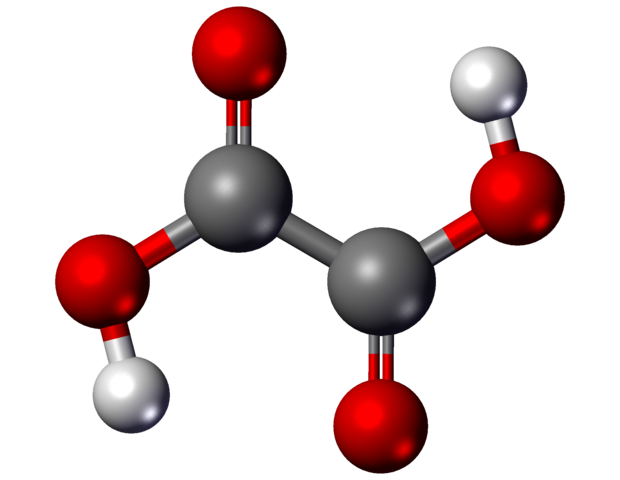
Oxalic Acid molecule
(Wikimedia Commons, Public Domain)
I mentioned in a previous post that I would go into some more detail about Varroa treatments.  The first one - and the one usually applied in winter, is oxalic acid.  But what is it?

Before we get to that, a quick reminder of how atoms work.  They consist of a nucleus, which contains one or more protons - each of which has a positive electric charge.  The nucleus usually contains neutrons too - but we don't need to worry about that right now.  The other component of the atom is electrons - each atom has one or more of these, and they are negatively charged.  The nucleus is at the centre of the atom, with the electrons round the outside, which is why schools often teach that atoms are like mini-solar-systems.  (Proper physicists can explain - at length - why that isn't actually true.  But we don't need to worry about that today, either.)  Now, molecules are basically two or more atoms stuck together in a particular way.  All clear so far?  Good - onto oxalic acid:

Firstly, it's an organic acid.  Let's look at what that means.  Organic has a (somewhat) specific meaning in chemistry - it means that each molecule of the chemical contains the elements carbon and hydrogen, and that it (usually) contains a carbon-hydrogen bond.  This, in turn, means that the molecule contains a join between at least one carbon atom and at least one hydrogen atom, and this is a covalent bond - which means that the bond is formed by the hydrogen atom sharing its electron with the carbon atom.

However, this definition is a little arbitrary, because there are certain organic chemicals that contain carbon but lack a carbon-hydrogen bond.  And, wouldn't you know it, oxalic acid just happens to be one of these exceptions.  So, oxalic acid is organic because basically chemists say it is.

Secondly, oxalic acid is an acid.  An acid (strictly speaking, a Brønsted acid) is a chemical which has a molecule that is structured such that it can donate one or more protons to another molecule.  A proton is a hydrogen nucleus - in other words, a hydrogen atom but without its electron.  And oxalic acid belongs to a group called the dicarboxylic acids, which (to simplify somewhat) means that it can donate two protons.  This then gives the molecule two negative electric charges (because it has donated the protons - the hydrogen nuclei - but kept the two electrons from the hydrogen).  It is the donation of the two protons, and the resulting double-negative charge, that makes the oxalic acid chemically reactive, and makes it an acidic reaction.

Oxalic acid was originally isolated from wood-sorrel (Latin genus name Oxalis).  Fun fact - it occurs in relatively high concentrations in rhubarb leaves, which has given rise to the idea that women used to slowly murder their husbands by feeding rhubarb leaves to them.

So, why oxalic acid?  Well, it's no coincidence that it occurs naturally in wood-sorrel, rhubarb, and lots of other plants.  They have evolved the production of oxalic acid, particularly in their leaves, to discourage invertebrates and larger animals from eating them.  So, from this we know that it's toxic to invertebrates - which includes insects and arachnids.

The Varroa mite is an arachnid - which means that it is susceptible to oxalic acid poisoning.  The actual mode of action is interesting.  The acid is applied by first dissolving in a 1:1 (by weight) sugar syrup, to create a solution that is 4.2% oxalic acid.  This is then trickled into the hive, so that it falls onto the bees between the frames of wax comb.  It appears the bees don't tend to consume much of the liquid (though there are different studies with different data about this).  What does happen is, as the bees move around the hive, the oxalic acid solution gets spread around on their bodies, and gets smeared into smaller and smaller droplets.

Once the droplets are small enough, the water evaporates off leaving sugar and oxalic acid crystals.  The sugar isn't important, but the oxalic crystals are.  They are now on the bees' bodies, which is also where the Varroa mites are.  As they walk around on the bees, the mites pick up oxalic crystals on their feet.  The crystals then dissolve on the feet of the mites.  What happens next depends on which study you read.

One version says that the oxalic acid damages the mites' feet (strictly speaking, the cuticles at the end of the legs), causing them to lose their grip on the host bee and fall off.  This happens because the mites' feet are made of chitin, which is a long-chain polymer similar to cellulose.  The polymer chains are held together by hydrogen bonds (sorry, more chemistry), which are held together by electrostatic forces.  Remember that oxalic acid works by donating positively-charged protons and thereby becoming negatively charged.  All this positive-negative charge jiggery-pokery interferes with the hydrogen bonds, which causes the chitin polymer chains to separate from each other, irreparably damaging the feet of the mite.

The other version is that the oxalic acid is absorbed through the mites' feet and travels through the haemolymph (the internal liquid they have instead of blood).  The exact effect of the toxicity is not clear - although damage to the mites' mouthparts has been reported.  Since these are also made of chitin (as are pretty much all hard parts of the mite) it may well be the acid's interference in the hydrogen bonds that causes Varroa mite mortality.

While a 4.2% solution of oxalic acid is at too low a concentration to cause much harm to adult honey bees, there is some evidence that it can damage brood.  Also, oxalic acid treatment only affects mites that are on the adult bees (known as the phoretic stage) - not the mites that are in the brood cells with the larvae.  For both these reasons, it is therefore best to undertake oxalic acid treatment when the hive has little or no brood.  The colder the weather, and the shorter the daylight hours, the less brood there will be in the colony.  Which is why most beekeepers tend to treat between the winter solstice and the end of the year.  And why I was out on a cold December day over the Christmas holidays, dribbling oxalic acid solution into my hives.

There is another organic acid that is also used as an anti-Varroa treatment, which we'll look at next time.

Saturday, 20 January 2018

Looking Back, and Forward

I know my regular readers are a clever lot, so I'm sure you all know that January is believed to be named after the Roman god Janus.  (And, if you're really clever, you know that this might not actually be true... but I digress.)

Anyway, Janus is depicted with two faces, one looking back to the past and the other looking forward to the future.  So, it being January at the moment, let's take a look back over the past year of beekeeping, and then see what might be happening in the year ahead.

2017 - What Went Well?


Honey!

It was a bumper crop this year - my best yet, yielding a total of 80 jars of honey.  But why?  I think it was down to two things.  Firstly, the bees had over-wintered better, which I think is at least in part due to my conversion of the hives from the British National design, to WBC.  This creates a second, outer hive wall, with a cavity between the inner and outer walls.  The effect of this seems to be better temperature control inside the hive - and possibly also a reduction in dampness.  Anyway, I certainly had more bees at the beginning of the season than I've had in previous years.

Secondly, the weather (until mid July) was just perfect for flowering plants and blossoming trees - warm, sunny but with enough rain showers to keep the plants sufficiently watered.  Sadly, I can't control the weather, so I can't claim credit for this - it was just a lucky year.

Bottoms up!

Propolis Gin

This was a fun surprise from Sue, our local apothecary.  I'd basically taken the propolis in and said "can you do anything with this?"  Well, after six months steeping in gin, Sue had done something quite wonderful with it, and created a rare and fine beverage!

More Bees

As well as growing the number of bees in the hives, I ended up doing three colony splits this year (two for swarm control, and one a "retirement plan" for queen Miriam).  This meant that I was able to sell two nuclei - one to Bath's Mayor Ian, who started beekeeping this year, and the other to local beekeeper Jack.  The third nucleus was kept in my apiary as a spare, so that if I lose either of the hive colonies over winter, I can replace it with the colony in the nucleus.

However, having a lot a bees has its drawbacks...

2017 - What Went Badly?


Too many bees?

I like to try one new beekeeping technique every year, and this year it was the "brood-and-a-half" hive configuration.  This allows the queen to lay in one of the super, as well as the brood box, enabling her to make far more bees.  Did this work?  Yes, very well - too well, in fact.  By the middle of June, the colony in hive #2 had become so large they were almost unmanageable, and I had to go back to the single-brood configuration just to calm things down a bit.  Which brings me onto...

Temper

This is the first year when I have undertaken a couple of beekeeping sessions that I didn't really enjoy.  That's because this year, for the first time, my bees became bad-tempered - which meant chasing me round the apiary and stinging me a lot more than usual.  On one occasion this can probably be explained by an approaching storm, which discombobulated them.  And then there was the incident with the spider.  But I also suspect that genetics have had a role to play.  All my bees are descended from my original queen, Rosalind.  My queens have mated with a variety of drones over the years, and no doubt some of their suitors have been more suitable than others.  But at some point, a genetic disposition for bad temper has found its way into the bloodlines.  The normal way to deal with this is to remove the queens, and replace them with new queens from a breeder that raises very gentle bees.  However, I like the fact that all my bees originate from my first queen, and so (somewhat sentimentally) I don't fancy replacing any of my girls.  Of course, the fact that I name all of the queens probably doesn't help...

Burn it with fire...
Sickness

I have taken a bit of a laissez-faire approach to managing combs this year - for example, I didn't undertake a full shook-swarm on either of my hives.  I should have known better - and my sloppiness caught up with me.  Firstly, the colony in the Blue Nucleus got a case of what I suspect was Chronic Bee Paralysis Virus (CBPV).  That forced me to do a shook-swarm on the colony, and burn the old brood frames.  A week later, and they were looking a picture of good health.  Lesson learned...

... or was it?  I still didn't change the combs in the hives (why?!) - and three months later hive #2 got sick.  This was a different illness - Sacbrood - and potentially more serious.  However, I discovered it in the second half of September, and this is way too late in the year to undertake a comb change.  So, I just had to leave them and hope that they survive the winter.  Fingers crossed that they make it to spring, when they will definitely be getting completely fresh comb!

2018 - What's Coming Up?


I have three targets that I want to achieve this coming season:
  • Change the comb for all the colonies - i.e. both hives and the nucleus.  Hopefully this will keep the bees nice and healthy this year.
     
  • Mark the queens!  I never got round to it last year, between all the other shenanigans and the wet weather in the latter half of the season.  Ideally, I will do this the week after the comb change.
     
  • Deal with my bad-tempered queens.  Since I'm basically relying on them randomly choosing to mate with drones from good-tempered families, I haven't given myself much in the way of options here, other than crossing my fingers and hoping for a good result.  Unless I manage to come up with a cunning plan...?

Also, I'll be working with Ian again as he settles into his second season of beekeeping - and discovers the joys of trying to stop his bees swarming.  And I had a meeting this morning with some neighbours in Sydney Buildings who are interested in setting up a community beekeeping scheme.  One of the interesting options we looked at was a different hive configuration - the Top Bar Hive - which is a horizontal design that doesn't have any supers.  For those of you who watch Gardeners' World, this is the design that Monty Don has in his garden at Longmeadow.  It will be interesting to try out a hive design that I haven't experienced before, and see what happens.

So, another three months to wait until the warmer weather and the longer days, and then the 2018 beekeeping year will get under way.

Thursday, 28 December 2017

Dropping Acid with the Mayor of Bath

Beekeeping is not normally a winter activity, but there are a couple of jobs that do need to be done while the weather is cold, and the hives are quiet.  One of these is making frames.  I know that I will need 32 frames in the spring, to replace the combs in the two hives and the nucleus.  Plus, it would be wise to have 11 spare frames in case of anything unexpected, so that's a total of 43 frames needed.

Total made as of today?  0 frames.  Not going well so far...

I met with Ian this morning (regular readers will know Ian as the Mayor of Bath, and also the owner of my former queen Caroline) and he has already been busy putting together his new hive in preparation for a colony split in the spring.  So Ian is definitely winning the "best organised beekeeper" contest!

Apart from comparing carpentry progress, there was an important reason for Ian and me to meet today.  This was to give a varroa treatment to each of the hives - in this case, oxalic acid.  I'm going to do a more detailed post next month on varroa treatments, but for now the important thing to understand is that oxalic acid is absorbed by varroa mites (usually via the feet) and kills them when it reaches the body.

The method relies on the mites coming into direct contact with the oxalic acid, so any mites that are inside capped brood cells will escape the treatment.  For this reason, the application of oxalic acid works best when there is little or no brood.  And the time of year when bee hives have the least brood is on, or just after, the winter solstice.  This is because brood rearing is (in part) controlled by the length of day, and the shorter the days get, the less the queen will lay - particularly if the weather is cold.  Around the winter solstice (21st December in the northern hemisphere) the days are at their shortest, and brood rearing will be minimal, or stop altogether.  This means that most, or all, of the mites in the colony will be on the bodies of adult bees, where we can attack them.

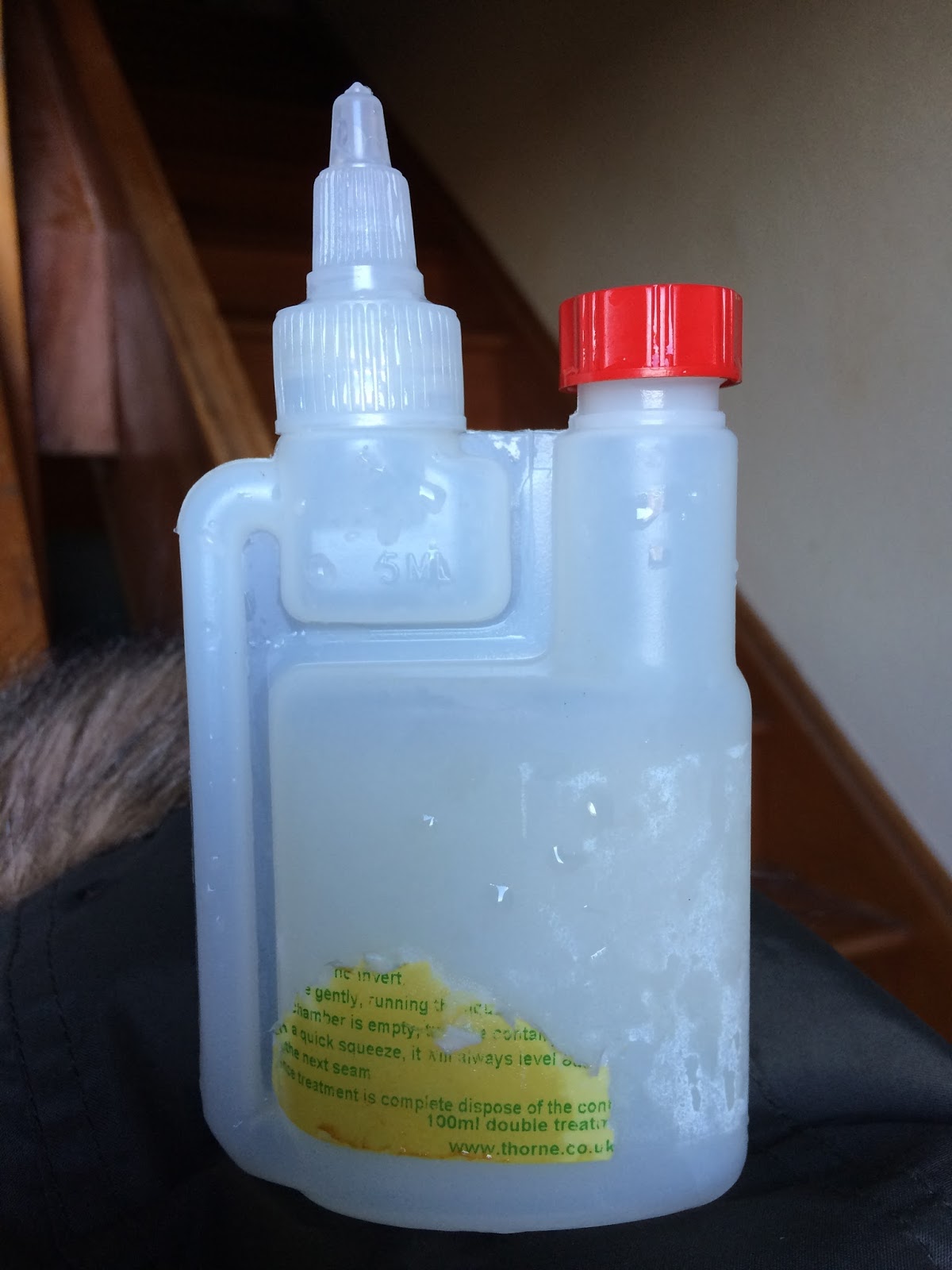
So, today being a chilly morning and one week after the solstice made it the ideal day for oxalic acid treatment.  Ian came prepared with a mix of oxalic acid dissolved in sugar syrup.  This is then put into a dispenser, which contains a 5ml reservoir.  What you do is squeeze the dispenser to fill the reservoir, and then trickle the acid/syrup mixture onto the bees.  Here's Ian doing just that:


And here's a closer look at the dispenser, showing the reservoir at the top-left:


The best technique involves trickling the mixture along the "seams" - i.e. the gaps between the top of the frames - so that it dribbles down onto the bees getting them nice and sticky.  As the mites walk around on the bodies of the bees, they get the mixture on their feet, and as it dries it forms oxalic acid crystals.  These then get absorbed through the mites' feet, and as the acid re-dissolves in the mites' haemolymph, it kills them.


So, with all of the hives treated for varroa, that's the last beekeeping task of the year done.  I hope you had a great Christmas, and I wish you all a very happy New Year!

Sunday, 24 December 2017

A Christmas Surprise

Regular readers may remember that back in March I wrote an article on propolis, which is a sticky substance that bees use for a variety of tasks.  Back in the summer, I had a big lump of it that I'd scraped off some old frames.  What to do with it?  Well, if one lives in Widcombe then the obvious thing to do is take it down to the local apothecary...

Yes - of course we have an apothecary in Widcombe - this is the Georgian city of Bath, and one-time home of Jane Austen.  What else did you expect?

Anyway, our local apothecary shop does double-duty as a gin distillery, and is run by the lovely Sue and Jade.  So, I took the propolis in and handed it to Sue, and asked if she could do anything with it?  Sue popped it into a bottle of neat gin, and advised that we wait.

So now, six months later, the gin and propolis have done some magical chemical dance inside the bottle.  After steeping for half a year, it has turned into a propolis tincture.  Sue has extracted some of this, diluted it in gin, and bottled it, and I was delighted to receive this from her yesterday:

Propolis gin - a rare beverage

Yes - it is what it says on the label - Propolis Gin!  An unexpected and delightful Christmas present.  Amelia and I have sampled it (of course) and it is a most intriguing tipple.  There are hints of wax, floral notes (particularly the bouquet) and a pleasant bitterness, with hints of pine trees and sap.  We are trying very hard not to drink any more, as this is definitely a drink for keeping, and sharing with guests.

Well, that about wraps it up for the year, except for one beekeepng task which I have scheduled for Thursday.  So, may I - and of course Laura, Maria and Elena (and all their daughters!) - wish you a very merry Christmas, and a happy and healthy New Year!

Monday, 20 November 2017

The Love of Gloves - Part 2

Regular readers will know that I have been mulling over my glove options in advance of next year's beekeeping season.  And, more importantly, I have tried out a selection of gloves that I bought online, to see how well they suit beekeeping activities.  I'm going to compare them on three criteria, with marks out of 5 for each:
  • Are they sting-proof?
  • How much dexterity do they allow?
  • How good a grip do they provide?

I've also included, for comparison, bare hands (hint - not sting-proof!) and single-use latex gloves.  So, here are the reviews, and the all-important scores:

Bare Hands

Some beekeepers always do their beekeeping with bare hands.  I tried it once, and gave up after two stings in less than 5 minutes - and this was with a particularly gentle colony of New Zealand origin.  My problem was simple - I'm a bit sweaty.  If you sweat near bees they will smell it - in fact, bees have evolved an aggression reaction in response to mammal sweat.  This is because wild colonies can be subject to attacks by large mammals such as bears, so whenever bees smell bear sweat (or any mammal sweat) they will defend their hive.  Needless to say, bare hands offer no protection against stings - you just have to hope that the bees aren't in the mood to sting you.  On the plus side, if you are very non-sweaty, have very kind bees and are prepared to put up with the odd sting, then bare hands provide excellent dexterity and grip.  But for me, that trade-off ain't worth it.
  • Sting-proof:  0
  • Dexterity:     5
  • Grip:             5

Latex Gloves

Until this season, latex gloves were my go-to choice.  They actually don't provide much better sting-proofing than bare hands, though they do hold the sweat in, so the bees don't smell it and get angry.  Also, if you do get stung wearing latex gloves, simply pinching the glove at the site of the sting and pulling out around half an inch will be enough to remove the sting - if you can do this within 10 seconds of getting stung, it really reduces the effect.  Dexterity is pretty good, but the glove can occasionally get trapped between the frame lugs and the hive wall, which is irritating.  Grip is good, though if you get honey or syrup on the glove it can become a little slippy.
  • Sting-proof:  1
  • Dexterity:     4
  • Grip:             4

PVC Supertouch 23224 Fully Coated 45cm Gauntlet EN388 (4131)

The last four gloves all have EN388 ratings.  For glove nerds, or anyone else who finds this interesting, EN388 is a European standard for rating glove safety in four areas - abrasion resistance, blade cut resistance, tear resistance and puncture resistance.  Each of these is given a rating of 0-4, and then the ratings are put together (in order of abrasion, cut, tear and puncture resistance) to give a 4-figure number, which is the EN388 rating.  So, taking the Supertouch 23224 as an example, it scores 4 for abrasion resistance, 1 for cut resistance, 3 for tear resistance and 1 for puncture resistance, hence its EN388 rating of 4131.

You'd think the puncture resistance would be the factor that would matter most to a beekeeper.  And you'd sort-of be right, except that the test uses a 4.5mm rounded stylus which is pushed 50mm into a sample of the glove at a constant speed of 100mm/min.  This is quite different from a bee sting, which is really more comparable to a very thin, sharp needle.  So, the EN388 rating doesn't actually help us as much as we'd like in selecting a good beekeeping glove.

Nevertheless, I can attest that the Supertouch 23224 is most definitely sting-proof, as demonstrated by one very persistent bee yesterday who took it upon herself to give her life in the pursuit of rigorous glove testing.  The problem is that it's blooming bulky.  For doing things like lifting hive boxes, or taking the roof off to feed syrup, it's a good glove.  But for getting inside the hive and lifting frames, it just doesn't allow the sensitive finger movement that's required.  also, it can get quite slippy if you get syrup on the finger-tips.  So - good for shifting stuff around the apiary, but no good for hive inspections.
  • Sting-proof:  5
  • Dexterity:     1
  • Grip:             3

Nitrile Ansell 37-185 Sol-Vex Gloves EN388 (4102)

I like this glove.  It's a little thinner than the Supertouch 23224, but the payoff is better dexterity.  I've tried this for a hive inspection and found it had pretty good grip, and allowed for a fair amount of finger movement while still offering good sting protection.

The glove fits snugly to my hand, but unfortunately is a little too tight - one of the problems of internet shopping is you can't try for size.  However, it is available in a larger size, which I will be ordering ready for next season.

  • Sting-proof:  4
  • Dexterity:     3
  • Grip:             4

PVC Supertouch 22834 Double Dip 45cm Gauntlet EN388 (4121)

This is another solid, heavy glove.  Unfortunately, that means it shares many of the same problems as the Supertouch 23224 red gauntlet.  It's slightly less bulky, which means dexterity is a little better, though not much.  What it does have in its favour is a flocked surface on the fingers, which gives it much better grip than the Supertouch 23224.

As with the Supertouch 23224, it's fine for doing external work such as rearranging supers and brood boxes, but too bulky for lifting frames inside a hive.
  • Sting-proof:  5
  • Dexterity:     2
  • Grip:             4

Ansell 37-900 Premium Sol-Vex Gauntlet EN388 (4102)

This one is the lightest of the four that I ordered.  In fact, it's only a little thicker than household washing-up gloves such as Marigolds.  That means less sting protection than the others (though still better than latex).  I also found these very slippery if I got syrup in them.  They allow better dexterity than the heavier gloves, though not noticeably better than the Ansell 37-185.  Probably useful for a fairly calm colony, or a nucleus, where the chances of receiving a sting are lower.

  • Sting-proof:  3
  • Dexterity:     3
  • Grip:             2

So, that's the review - but what's the verdict?  Well, I can confirm that the winner of the "Which Glove Will Andy Be Wearing In 2018" competition is...

The Ansell 37-185!  It's a good, versatile glove - sting-proof, but still with enough dexterity and grip to handle all the various in-hive tasks including frame-lifting, queen-marking and syrup-feeding.  I will be ordering three more pairs - in the larger size 9 - shortly (unless someone fancies buying me a pair or two for Christmas...?!)