Saturday, 19 June 2021

Meet The Queens

I opened up the hives last weekend, as I wanted to see how the bees were getting on with building comb, and also wanted to check if I had queens - and if they were laying.  Yes, and yes! - here's the queen of hive #1 (the mystery swarm):

And this is the queen of hive #2 (the swarm I collected):

Interestingly, the queens (and their bees) are quite different.  Queen #1 is a mid-amber colour with very thin dark bands, and so are her bees.  I would guess from their coloration that they are descended from Italian honey bees (Apis mellifera ligustica).  Queen #2 is a little darker, with wider black bands, and her bees are much darker with very wide black bands.  They are Apis mellifera mellifera, the north European honey bee.  I wonder if I will see distinctly different behaviour from the two colonies?

As for comb building, this is what they'd done with the small piece of comb that I wired into a frame the previous week:

Both colonies had drawn 5 frames of wax (i.e. half the brood box).  Here's hive #2 with one (drawn) frame removed, so you can see their progress:

All looking good so far, so the next task will be to mark the queens.  Regular readers will know that I name my queens when I mark them, so I will have to decide on new names.  My previous bloodline (all descended from my first queen, Rosalind) were all named after scientists and engineers.  This time, I might look at a different discipline - or possibly two separate naming schemes, one for each bloodline.  That will probably be a task for this weekend.

Monday, 31 May 2021

New Bees! - Part 2

So, last time I collected a swarm, and just as I was finishing up I noticed that my box of spares had got out of alignment - and some bees were now hanging around the unplanned entrance:

I had a closer look, and there was indeed a gap at the bottom of the one of the boxes, wide enough to let bees in and out:

There were some previously-used honey frames in the stack, and I wondered whether the bees had smelled the wax and had popped in to see whether there was still any old honey in the comb that they could steal for an easy meal.  I thought I'd better take a look, so I took the roof off, and carefully lifted the crown-board for a better look.  Well, this was a surprise: 

Yes, that is a swarm of bees!  They'd clearly decided to ignore the two fully-furnished 'bait' hives that I'd left open and available, and had instead chosen to spurn the designer residence option and opt for a 'doer-upper' instead.  As you can see, they'd already started making themselves right at home by building some new comb, which they'd attached to the underside of the crown board.

That was Friday morning, and I really needed to get back to work.  So I carefully closed up and left them to it.

On Saturday I had plenty of time, and some fair weather, so I collected everything I might need (bee jacket, smoker, two hive tools and secateurs, as well as some waxed and unwaxed frames) and headed back to see if I could sort it all out.  The first job was to open up one of the hives, and take all the frames out so that I had an empty brood box to start moving the bees into.

The next task was to shake the bees off the crown-board and into the hive.  That left the new comb exposed - which I didn't want to waste, as the bees have worked so hard to make it (it takes around 10 millilitres of honey to make 1 gram of wax, so it's an expensive business for the bees to produce it).  I carefully cut the two pieces of new comb off the crown-board, with the idea that I might be able to re-use them.

I had to improvise, so I picked some foundation wire out of one of the waxed frames, snipped it off with the secateurs, and used it to attach the two pieces to an unwaxed frame.  This new frame then went into the brood box, and hopefully the bees will re-attach the comb properly to the top of the frame:

There were still plenty of bees (maybe half the swarm?) in the stack of spare boxes.  So the next job was to move the rest of the boxes in the stack over to the hive, on top of the brood box, and let the bees slowly make their way down:

And then take the boxes off, one at a time...:

... until all the bees were in the brood box.  You can see from the the following picture how many bees were outside the hive - imagine how many there are inside!

Finally, stack the outer wall ('lifts'):

Put the roof on - and we're done!

So, that's now two swarms successfully hived in one weekend!  I'm pleased (and surprised) that I didn't get a single sting while doing any of this.  Both colonies seem to be pretty gentle and good-natured, so I'm hoping that means I'm going to have a pleasant and relaxing summer of beekeeping.

Sunday, 30 May 2021

New Bees!

Yes, it's absolutely true - on Friday morning I got a text from fellow Bath Rugby fan Mark, to say that his neighbour had a swarm in the hedge in his front garden.  This, obviously, was too good an opportunity to miss, so I grabbed a bee jacket, nucleus and secateurs, and headed over.

Well, he was absolutely right - a lovely sized swarm, nicely located at waist height in a cotoneaster bush.  Mark was happy to take photos while I got to work:

With the nucleus in place below the swarm ball, I grabbed the secateurs and started cutting:

Here are the bees after I'd shaken them off the branch and into the nucleus:

Put the frames in:

Roof on, and wait for the stragglers to walk down into the entrance:

Then I closed the entrance block, popped them into the boot of the car, and drove up to the apiary to place them in their new home.  And here they are - happy, and flying about:

So the happy news is that I now have bees, and The Southdown Apiary is now a proper apiary!  I must admit I was feeling pretty pleased with myself now that I've caught a swarm and can call myself a beekeeper again.

I have the apiary laid out so that the hives are on one side, and the stack of spare boxes (spare supers and frames) on the other, with the nucleuses (nuclei?) at the far end.  So, satisfied after a successful swarm collection, I was walking back out of the apiary past the 'spares' stack, when I noticed the boxes were out of alignment:

My guess is Joel's dog, Iris, had been sniffing around and had knocked the boxes slightly out of kilter.  But then I noticed some bees buzzing around one of the mis-aligned corners.  I wonder...

Friday, 30 April 2021

Welcome to The Southdown Apiary!

The hives are moved, the website is re-directed, there is a new - albeit temporary - logo, and I have a shiny new email alert service - welcome to The Southdown Apiary!  (Which, if you hadn't already worked it out, is the blog formerly known as Beechen Bees).  I have everything I need for an exciting year's beekeeping... except... no actual bees.  Yet.  But swarm season is almost upon us, so I am somewhat optimistic that will get sorted out fairly soon.

The hives are ready - we just need some bees!

In the meantime, I have still been able to do a bit of beekeeping - the folk with the ZEST hives kindly invited me over last weekend to join in with their routine inspection, and I'm pleased to report that their bees are doing very well.  No winter losses, and the colonies are building up nicely.  The bees had already started to build queen cups (though no queen cells, yet), so they are at least starting to think about swarming.  Also, there were already quite a few drones around, which is a sign that swarming is on the cards sometime in the next few weeks.

While I wait for some bees to turn up, I have a few other tasks to get on with, including making up some new brood frames - all my previous stock of new frames went into the freshly cleaned hives, and I currently don't have any for the nucleus hives.  But a box of parts for 50 frames arrived on my doorstep this week, so I have plenty to do to keep me busy over the bank holiday.

The weather next week looks like rain - so there may not be any news about new bees for a couple of weeks.  I will keep you all posted if and when something happens!

Sunday, 18 April 2021

Goodbye Beechen Bees - Epilogue

Spring is in full swing, the blossom is out, and the bees should be flying by now.  Sadly, mine are not.  I opened the hives last month, and found piles of dead bees, and some nasty mould:

I don't know exactly what killed them - probably some kind of virus, such as chronic bee paralysis virus.  Almost certainly spread within and across the hives by Varroa mites.  But it means - currently - the end of all my bees.  It's a shame, as they were all from the same family tree, right from my first colony that I got back in 2012, headed up by queen Rosalind.

Anyway, before I can get new bees, I needed to clean things up.  The first task was to burn all the frames.  They could still be harbouring the infection that killed my bees, so I can't take the risk of using them again.  The best way to dispose of old frames is to burn them.  They do burn well:

The next task was to scrape off any remaining propolis on the brood and super boxes, and sterilise the remaining hive parts.  This is done with a blowtorch.  The idea is to work fairly quickly, so as to scorch the wood but not burn it.

Then, I put new frames in.  Acting on a tip from fellow Widcombe beekeeper Jessica, I put in 10 new frames of wax foundation, and also a frame of drawn wax from one of my spare super frames:

The idea is that any passing swarm might smell the wax, take a look inside, and find an empty - but fully furnished - beehive all ready for them to move into.  New bee landlord Joel assures me that he usually gets a swarm in either his, or his neighbour's garden, every spring.  So, if I'm lucky, I might find a passing swarm setting up home in one of my hives.  That, at least, is the theory - we'll see how it works out over the next few weeks.

This will be my last blog entry as Beechen Bees.  But - assuming I do get some bees, one way or another, this season - it won't be the last you'll hear of me.  Stay tuned for some news from The Southdown Apiary!

Monday, 8 February 2021

Goodbye Beechen Bees...

A couple of posts back, I talked about moving the nucleus to Joel's garden in Southdown.  This was part of a larger plan to move the whole apiary over to Joel's garden over the winter.  I've been moving various items (slabs, spare boxes of frames etc.) over the last few weeks.  On Saturday, having checked that the weather conditions were suitable (dry, cold, no wind) I decided that it was time to move the hives.  It was a two-person job, and with COVID still keeping us in lockdown, there was really only one option - I roped Mrs Beekeeper into the action.  She was... quite tolerant of being 'volunteered' for the task.

Moving hives is normally straightforward - you close up the entrance, tape up any bits you might be concerned about, and ratchet strap the whole thing together.  The rest is just lifting.  However, my hives use the double-walled 'WBC' design, which meant I first had to remove the outer walls, and strip them down from this:

To this:

Notice the hive roofs are different - I swapped them for national-sized roofs for the journey.  Once that was done, and the straps were on, we could start moving:

Carrying beehives up three flights of steps
Car loaded...
... and unloaded
We need a wheelbarrow!
Let's load it up...
And get moving
Hives in their new location
Need to re-assemble the outer walls of the WBC
Roof back on...
... and we're done!

So, is this the end of Beechen Bees?  Yes, and no.  It's certainly not the end of the bees - I will continue to look after them in their new location on Joel's garden.  But they're no longer next to Beechen Cliff, because the new location is in Southdown.  So, I'll be looking to re-brand this year, and will want a new name for the bees (and this blog).  I'm open to suggestions!

Sunday, 13 September 2020

HARVEST!

Each hive has produced one super (ten frames) of surplus honey this year, and I've been waiting for the right time to take them off the hives.  Last weekend was fairly dry, weather-wise, so I figured it was probably my best chance to get harvest done.

This year, I needed to be extra-careful with hygiene arrangements because of COVID-19 so as well the the usual tasks of thoroughly cleaning down the utility room and laundering the aprons and hats, we also wore clean masks throughout to minimise any transmission risk.  I'm also going to quarantine the sealed jars for 14 days, just to be sure that neither of us were infected when we did the extraction.

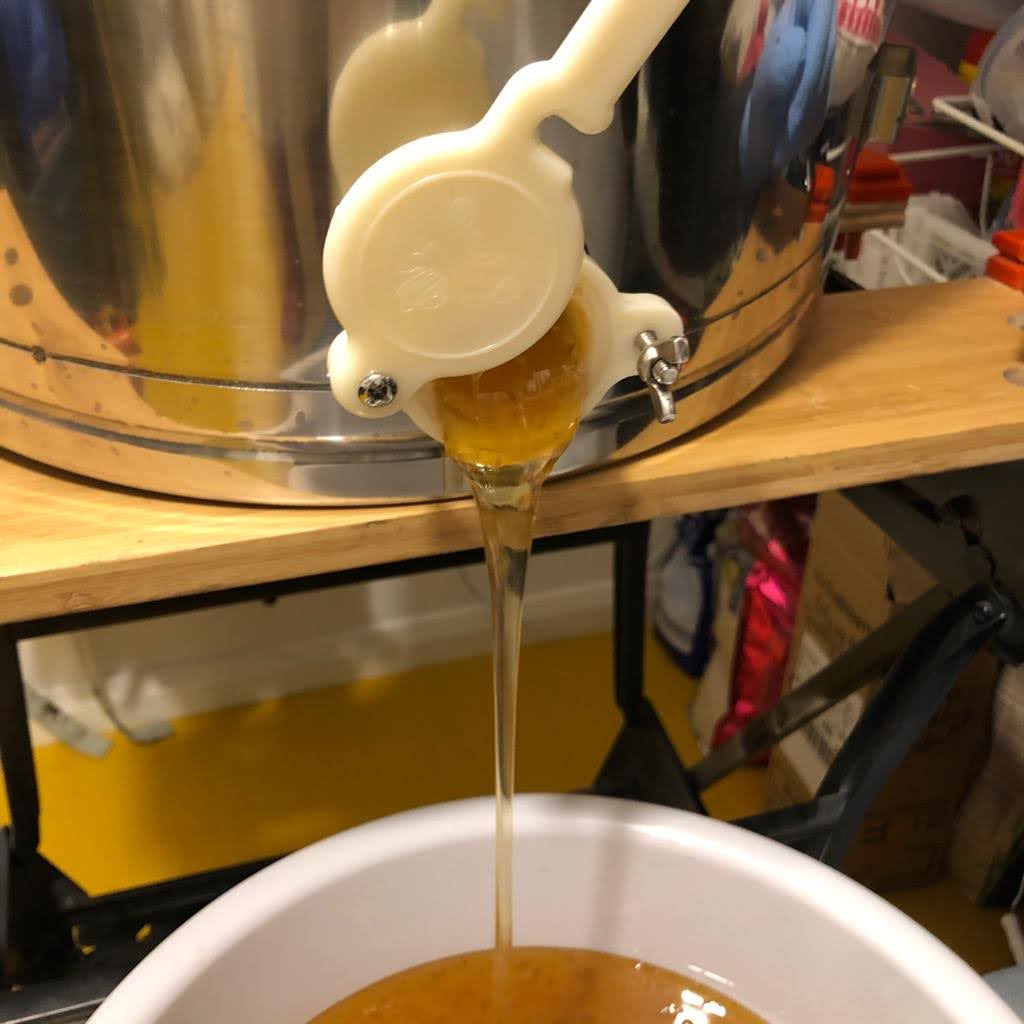
Mrs Beekeeper was on hand to uncap the combs, while I worked the extractor.  Here's a couple of action shots of us hard at work:


The final haul is 7 jars from Athene's hive and 9 jars from Ottoline's bees.  Not my best year ever, but at least it will be enough for a few stocking fillers at Christmas.  And it's always satisfying to have a little reward at the end of the season.